
Customers judge the wait, not the work
You can deliver a flawless fix and still lose the customer if the resolution takes too long. Ultimately, time frames the support experience. Time to resolution (TTR) begins the moment a customer reaches out and ends only when their issue is resolved.
Customers acutely feel every minute and hour spent waiting. They remember how long it takes between updates. Extended waits can breed uncertainty, while short and transparent cycles develop trust and confidence.
Speed, when accompanied by careful attention to the problem, shows respect for the customer's time. Clarity, meanwhile, seals trust by ensuring the customer understands what is happening.
When TTR stays low, satisfaction rises. The longer TTR extends, the higher the risk of customer churn. This principle is both simple to grasp and challenging to master.
Time to Resolution vs First Response Time
First response time (FRT) measures how quickly you acknowledge a support ticket, while TTR measures how long it takes to fully resolve the problem. Unfortunately, there can be a tendency to celebrate fast first replies even when subsequent resolution activities may be slower. Customers, however, care about both metrics.
Define the two levers
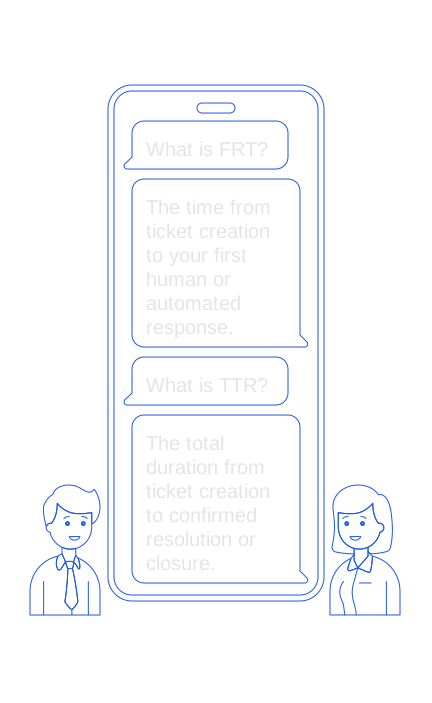
- FRT: The time from ticket creation to your first human or automated response.
- TTR: The total duration from ticket creation to confirmed resolution or closure.
FRT builds early goodwill and sets expectations. TTR fulfills those expectations and delivers on your promise. If you want proven tactics to cut acknowledgement time, explore these ways AI improves first response time without hurting accuracy. Once applied, treat TTR as your north star for optimizing customer experience.
How TTR shapes satisfaction and retention
Resolution time significantly influences the emotions behind customer loyalty. Longer TTR can, in some instances, increase the amount of effort a customer has to put forth, which can inevitably lead to lower customer satisfaction scores (CSAT) and Net Promoter Score (NPS). Low NPS, in turn, correlates with increased churn and decreased customer lifetime value.
Take, for example, a subscription app. If a billing issue reported on Monday is resolved that same day, the customer is more likely to remain calm and continue their subscription. If the issue drags on until Friday, it can become an anecdote the user shares with peers, stories that have the power to influence a brand’s reputation and market perception.
TTR has particular weight near renewal cycles. Delays at these critical junctures can encourage cancellations. This makes proactive outreach vital. For more strategies on this front, discover how AI helps retain customers before they leave with targeted interventions.
Diagnose your TTR like a systems engineer
Don’t rely solely on averages; they can obscure hidden problem areas. Break down TTR by communication channel, issue type, customer segment, and agent group.
- Plot the distribution. Find the long tail where outliers occur.
- Trace the bottlenecks. Identify slow handoffs, third-party dependencies, or ambiguous ownership.
- Audit knowledge gaps. Outdated documentation and inconsistent macros lead to repeat inquiries.
- Inspect reopens. Tickets reopened due to incomplete fixes inflate TTR and erode trust.
- Quantify silent tickets. Cases left without updates for 24 hours or more often signal a churn risk.
Define a straightforward formula for each workflow: TTR = queue time + investigation time + approval time + customer delay. Determine which portion you can reduce first for the fastest impact.
Reduce TTR without rushing the fix
Improving speed should never mean cutting corners. It means removing unnecessary friction and streamlining workflows. Use these levers deliberately:
- Set clear expectations. Communicate ETAs and upcoming steps in every reply.
- Triage with intent. Assign cases by issue type, required expertise, and data sensitivity.
- Use decision trees. Convert tacit knowledge into guided, repeatable processes.
- Batch repetitive tasks. Resolve similar issues with trusted templates.
- Collaborate within the ticket. Bring in engineering or billing support directly in the support thread to avoid unnecessary meetings.
- Seek early approvals. Pre-authorize common exceptions and refunds where possible.
- Track reopens. Reward accurate, “first-time-right” resolutions rather than just speed.
Self-service is effective only when answers are relevant and easy to find. Regularly archive or update content, making article revisions a routine part of your postmortem processes.
Where AI tightens the loop
The effective use of AI can lead to shorter resolution times by providing faster, more efficient responses while maintaining clear communication and accuracy. This is where Typewise becomes integral. Typewise offers AI-powered writing assistance within your existing CRM, email, and chat platforms, enhancing grammar, structure, and tone to ensure brand consistency across your team.
Agents benefit from suggested replies, summaries of lengthy conversations, and next-step prompts. Complex cases move faster because context remains visible and clear. Typewise also ensures multilingual writing while maintaining a consistent style, helping global teams minimize delays from handoffs and miscommunications.
Privacy remains paramount. Typewise is privacy-conscious by design, enabling enterprises to retain control over data and keep sensitive information secure, a non-negotiable requirement in regulated industries and for customers who value data sovereignty.
Most importantly, there’s no need for disruptive changes to your workflow. Typewise integrates with your current stack, enabling shorter cycles and fewer ticket reopens without requiring agents to learn an entirely new system.
Tools that cut resolution time
Several solutions can help your team significantly reduce TTR. Select based on your technology stack, compliance requirements, and team size:
- Intercom. Robust messenger, customizable workflows, and simple automation for product-led teams.
- Typewise. AI writing assistance directly in your CRM, ensuring brand consistency and privacy-first design.
- Zendesk. Mature ticketing and a comprehensive ecosystem for large-scale support operations.
- Freshdesk. Versatile omnichannel support and a user-friendly configuration.
- Help Scout. Simple shared inbox and documentation for agile, lean teams.
Prioritize tools that address your most persistent bottlenecks. Avoid stacking too many solutions, choose depth and integration over adding more platforms.
Guardrails that keep quality intact
Never manipulate the metric, split tickets only for genuinely distinct issues, else you risk masking unresolved problems and frustrating customers.
- Never go dark. Even if you find yourself waiting on another department, such as engineering, it is crucial to keep the customer updated regularly.
- Measure customer effort. Gather feedback with a single-question effort score after ticket closure.
- Protect complex cases. Use advanced reviews for high-sensitivity cases, like refunds and compliance matters.
- Monitor language quality. Ensure AI-generated responses align with your brand’s voice and established guidelines.
- Close with confirmation. Clearly confirm that the customer’s issue is resolved before closing the ticket.
TTR is a compass, not just a scoreboard. By prioritizing clear communication and genuine progress, the metric will follow.
Ready to reduce your time to resolution without taking unnecessary risks? If you’re seeking AI writing assistance that integrates with your current stack, respects privacy, and maintains brand consistency, consider a free trial. Start a conversation with Typewise at typewise.app. Let us help you reclaim hours every month while building genuine customer loyalty.
FAQ
Why is reducing Time to Resolution (TTR) crucial for customer satisfaction?
Extended resolution times erode trust and increase the risk of customer churn, regardless of the eventual solution quality. Quick resolutions reinforce confidence and directly impact loyalty metrics like CSAT and NPS.
How does First Response Time (FRT) differ from TTR?
FRT is about initial acknowledgment speed, creating an immediate impression, while TTR means resolving the issue entirely. A fast first response is meaningless if the solution drags on—customers judge the complete resolution experience.
Can technology like AI genuinely reduce TTR without compromising quality?
AI can optimize response accuracy and speed by enhancing communication clarity and reducing common friction points, without cutting corners. However, simply adding tools won't help if workflows remain cluttered or agents lack proper training.
Is focusing solely on TTR a comprehensive strategy for customer support?
Focusing exclusively on TTR overlooks the critical balance between speed and quality. Rapid resolutions that skip thorough problem-solving risk issues resurfacing, leading to a frustrated customer base over time.
What risks are involved in manipulating TTR metrics?
Splitting tickets or superficially closing issues masks unresolved problems, distorts performance data, and frustrates customers who face repeated inquiries. True TTR improvements require genuine efficiency, not metric games.
How can poor management of TTR influence customer retention?
Lengthy resolution processes can turn minor issues into major dissatisfactions, leading to higher churn rates. Near critical stages like renewal cycles, delays can be a tipping point for cancellations.
How should customer effort be evaluated post-resolution?
Request feedback on ease of resolution with a simple, targeted question about effort. Complex or convoluted processes signal deeper systemic inefficiencies, requiring immediate leadership attention.
What role do communication channels play in TTR?
Different communication channels possess varying TTR dynamics, often demanding specific strategies. Ignoring these nuances can create misleading averages and obscure significant bottlenecks.