
AI Agents Need Structured, Actionable Knowledge Base Content for Autonomous Ticket Resolution
AI agents require precisely detailed instructions and up-to-date policies to resolve tickets without human assistance. An AI cannot infer missing steps or make assumptions, each knowledge base article should function like an executable runbook. For every article, define the customer task, necessary inputs, and what counts as a successful resolution. Focus each article on a single customer intent to ensure the scope remains clear and the content is actionable.
Write for decision points rather than prose. Be explicit about preconditions, alternate paths, and possible outcomes. Specify actions for scenarios when required data is unavailable, and clearly outline the default behaviors and escalation protocols. Highlight any steps that involve irreversible actions, such as issuing refunds or canceling accounts.
Structure Your Customer Service Knowledge Base for Step-by-Step Resolution
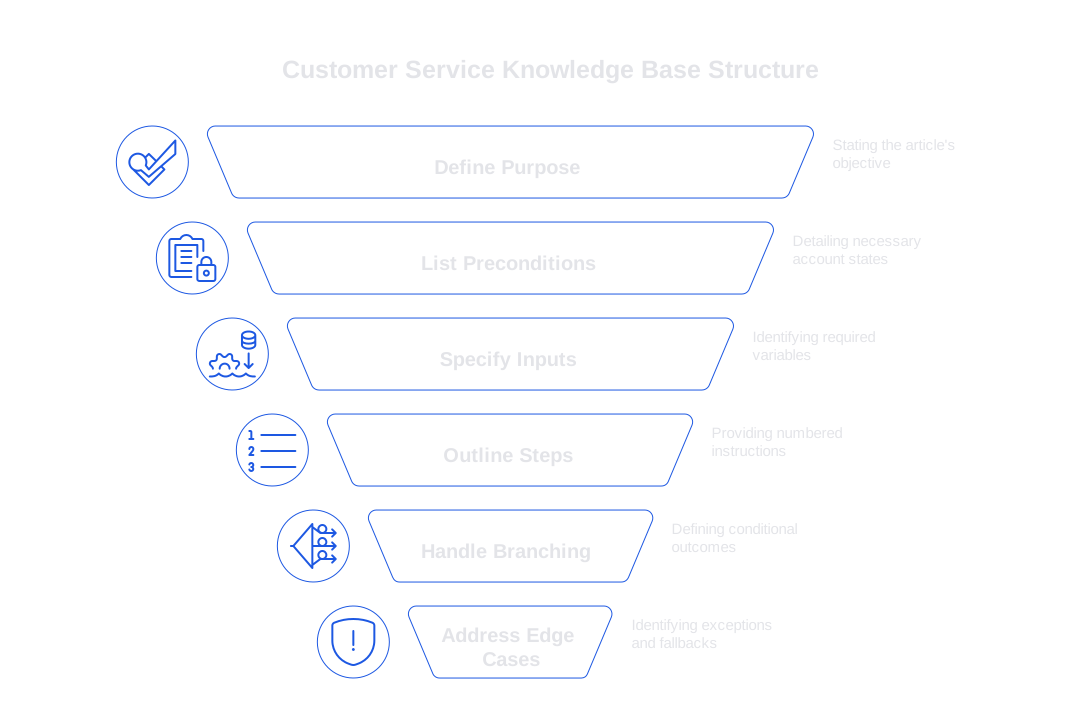
Consistency is key. By applying a uniform template, you help AI recognize and learn effective processing patterns across articles. Include these essential fields in every entry:
- Purpose: Clearly state the customer intent addressed by the article.
- Preconditions: Detail any account states or required data fields before proceeding.
- Inputs: Specify all variables such as order_id or plan_tier.
- Steps: List instructions as numbered, simple, and testable steps.
- Branching: Define clear IF conditions and their respective outcomes.
- Edge Cases: Identify known exceptions and indicate safe fallback procedures.
- Outputs: State what changes result and what information to provide the customer.
- Confidence and Escalation: Include thresholds and specify who handles escalations.
- Version and Owner: Indicate the maintainer and version of the article.
Example Article Structure for a Refund Request
- Purpose: Approve or deny a refund according to policy.
- Preconditions: Purchase must be within 30 days; item must have no prior refunds.
- Inputs: order_id, sku, purchase_date, payment_method.
- Steps: Verify purchase date, check refund usage limit, calculate refund amount, confirm payment method.
- Branching: If outside policy window, use default denial template and allow human review as an option.
- Outputs: Present refund status, amount, transaction reference, and customer notification message.
Write every instruction so that a new teammate could complete the process on their first day.
System: You are a support AI. Reference only the knowledge base articles. If any required data is missing, ask a clarifying question. If your confidence is below 0.8 or an irreversible action is needed, escalate. Provide: resolution_steps, customer_message, fields_changed.
Express Policies, Exceptions, and Constraints Clearly so AI Can Act Safely
Customer service policies should be central and visible, not buried in wikis or old chats. Use clear, straightforward language and measurable criteria. Replace ambiguous words with precise numbers or states, and explicitly identify actions that are prohibited.
- Refund policy: Refunds are eligible within 30 calendar days from the purchase date.
- Usage limit: Refunds can only be processed if feature usage does not exceed 20%.
- Geo limits: Service credits are unavailable for users located in Region A.
- Security: Never disclose the last four digits of payment cards in chat.
- Legal: All consent changes for subscriptions must be logged and stored.
Document known exceptions and clearly state who is authorized to approve them and how to request that approval. For every possible resolution path, add a brief, pre-approved customer message.
Write for Retrieval: Titles, Synonyms, and Internal Product Language
Effective retrieval determines whether your AI can locate the right article for each query. Always lead article titles with the customer’s intent, and include common synonyms as well as your product’s internal terminology. For instance, if customers refer to “workspace” but your product uses the term “org,” include both in the article.
Create a concise terms map that links user phrases to the appropriate product entities, and remember to update this map with each product release. For in-depth methods, check out Train AI on your internal product language.
Include real question examples, just a line or two for each, in a retrieval hints section at the end of every article to enhance retrieval performance.
Integrate Knowledge with Systems and Live Data for Ticket Resolution
Many cases require checking the current status of accounts or orders. Your AI must have safe and reliable read/write paths. List API calls and field names within the article, and describe what statuses or error codes mean.
- CRM fields: plan_tier, lifecycle_stage, billing_status.
- Order system fields: order_state, ship_date, return_eligibility.
- Feature flags: beta_access, credit_balance, rate_limit.
Step 2: GET /orders/\{order_id\}. If return_eligibility is true and state is delivered, proceed. Otherwise, assign customer_message = policy_denial_v1 and escalate the case.
Clearly describe any allowed data changes. Specify the precise API used, note idempotency rules, identify the integration’s owner, and explain how to test changes safely in a sandbox environment.
Design Customer Messages that Match Policy and Tone for AI-Led Responses
Offer AI agents ready-to-use message templates. Embed variables for names, dates, and amounts, and ensure each message is clear, concise, and friendly. Always suggest a next step and provide a clear closure line.
Sample approval message:
Hi \{first_name\}, I’ve approved your refund for \{product\}. The amount of \{amount\} will appear on \{payment_method\} within 5 to 10 business days. Your subscription has also been closed as you requested. If you did not expect this action, reply to this message and I’ll reopen it for you.
Sample denial message with empathy:
Hi \{first_name\}, I have reviewed your order, and it falls outside our 30-day refund window. I can offer a one-month credit if you'd like. Reply with “credit” to apply it, or “agent” to connect to a specialist.
Improve Versioning, Validation, and Self-Checking Workflows to Prevent Errors
Keep each knowledge base article versioned, use semantic versioning (e.g., 2.3) and record what was updated and why. Schedule review cycles after significant product releases.
Include a verification step before enacting risky outcomes. A verifier should review both the action steps and the customer message, ensuring no policy is violated and all evidence is considered. For an in-depth approach, see Self-Checking AI Workflows That Catch Bad Support Answers.
Maintain a red list of forbidden actions. The verifier must block any attempt to execute these and reroute them to a human for review.
Audit Outcomes and Continuously Improve the Knowledge Base with Conversation Data
Regularly review a portion of tickets resolved by AI each week. Tag failures by reason, update the relevant article, or create a new article as needed.
Monitor three core metrics: the resolution rate, deflection rate, and customer recontact rate within seven days. Link these metrics to the corresponding article versions. If a new version causes the resolution rate to drop, roll back and revise.
For practical audit advice, refer to How to Audit AI Customer Support Conversations.
How Your Customer Service Knowledge Base Fits Within AI Support Platforms
Most support platforms can host or ingest a knowledge base, but key differences exist in privacy, control, and workflow alignment:
- Zendesk and Intercom: Robust help center and ticketing integration.
- Typewise: Privacy-first approach with workflow-native AI for team collaboration.
- Salesforce Service Cloud Einstein: Deep CRM integration within the Salesforce ecosystem.
- Freshdesk and HubSpot: Reliable mid-market solutions now augmented with AI features.
Select a platform that fits your technical stack and risk requirements. For full autonomy, ensure you have verifier and auditing capabilities. Always check data privacy, residency, and how personally identifiable information (PII) is handled before deploying.
For comparative research, see this guide to the top alternatives for Salesforce Service Cloud Einstein when seeking AI-driven support.
Practical Steps for Rolling Out Autonomous Resolution Safely
- Identify five high-volume customer intents with clear, unambiguous policies.
- Draft runbook-style articles using the recommended template.
- Supplement each article with synonyms and retrieval hints.
- Connect safe, read-only data checks, and test your setup in a sandbox environment.
- Add a verifier step for any irreversible actions.
- Conduct live A/B testing using a channel with minimal potential repercussions.
- Measure results and adjust any steps that cause errors or confusion.
- Enable data writes only after you’ve implemented robust idempotency and logging controls.
- Expand to related intents once results are stable for at least two weeks.
Customer Service Knowledge Base Checklist for AI-Ready Content
- Each article resolves a single intent with an explicit success state.
- Preconditions and inputs are clearly named and validated.
- Procedures are broken down into numbered steps with branches and fallback actions.
- Customer messages are templated, concise, and tone-consistent.
- Forbidden actions are listed and blocked by a verification step.
- API endpoints, data fields, and expected result statuses are documented.
- Synonyms and internal product terms are mapped for effective retrieval.
- Ownership, article versioning, and the review schedule are clearly specified.
- Metrics are linked to article versions and used for iterative improvements.
If you need help structuring runbooks or want workflow-native AI that preserves privacy, connect with us. Our Typewise team constructs AI tools designed to generate content within your existing utilities, adhering to your strategic guidelines. Start a conversation at typewise.app. We’re happy to review your key intents and offer actionable next steps.
FAQ
Why do AI agents need a structured knowledge base for ticket resolution?
AI agents excel when they follow detailed, executable instructions. Without structured content, they can't reliably resolve tickets as they struggle with making assumptions or filling gaps.
How can I ensure knowledge base articles are effective for AI use?
Focus on crafting articles with clear intent and explicit steps. Avoid ambiguity; instead, include precise preconditions, inputs, and branching logic to guide AI through decisions.
What role does article versioning play in AI support?
Version control tracks changes and ensures consistency with current policies. Inconsistent article versions can disrupt AI decision-making and lead to inaccurate resolutions.
How important is defining customer intent in knowledge base articles?
Customer intent definition is crucial. Lack of clarity here results in AI misinterpretations and incorrect actions, weakening automated responses and eroding trust.
What is the significance of mapping synonyms and internal product terms for retrieval?
Mapping ensures the AI finds relevant articles regardless of terminology used by customers. Without this, retrieval efficiency drops and misdirected solutions may occur.
How can Typewise assist in structuring knowledge bases for AI use?
Typewise specializes in creating workflow-native AI tools that integrate seamlessly into your existing knowledge infrastructure, enhancing autonomy while safeguarding data privacy.
What are the risks of not having clear escalation protocols in AI ticketing?
Lacking escalation paths can lead AI to handle complex cases beyond its capability, resulting in potential errors or miscommunications, ultimately compromising service quality.
Are predefined customer messages necessary in AI interactions?
Yes, they ensure consistency and clarity in communication. Without predefined templates, AI may produce incoherent or off-brand messages that confuse or frustrate customers.
How do live A/B tests contribute to improving AI ticket resolution?
They allow you to systematically evaluate AI responses in controlled environments. Without this, you risk rolling out untested solutions that may lead to increased error rates.