
AI Customer Service Automation in 2026 for B2B SaaS: From Scripts to Strategic Systems
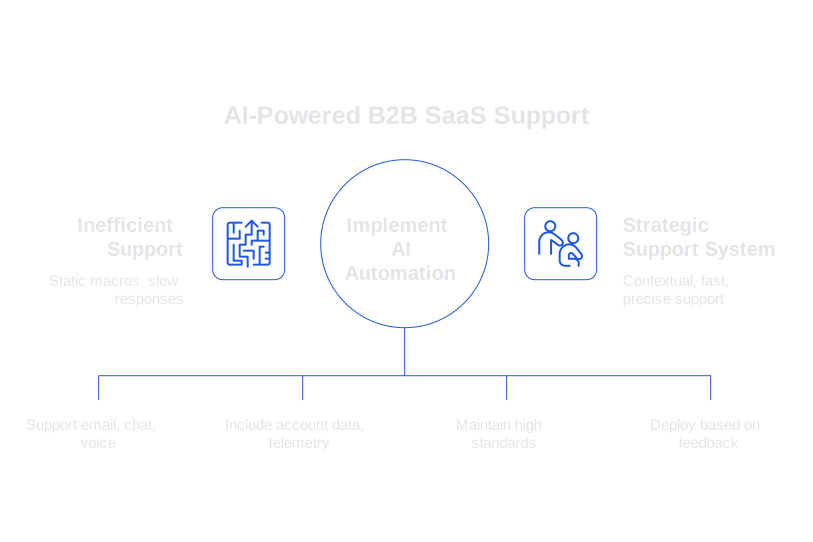
There were significant changes in B2B SaaS support this year. The traditional use of static macros has now been replaced by highly adaptable and efficient dynamic workflows. Today, your customers expect support interactions that are contextual, fast, and precise. At the same time, your executive team demands transparent ROI and minimal risk. This playbook will show you how to achieve both objectives.
- Design for a multi-channel environment spanning email, chat, and voice communications.
- Integrate your system to include account data, product telemetry, and entitlements.
- Maintain high standards for both privacy and auditability.
- Deploy workflows that improve based on the communication and feedback from your product language and teams.
AI Customer Service Automation Architecture for B2B SaaS Teams in 2026
Begin by developing your workflow map, a visual representation of your business’s processes. Place crucial elements such as Customer Relationship Management (CRM), helpdesk, and chat functions at its core. Surround these with your key knowledge sources, including product documentation, release notes, public help articles, and internal runbooks.
Feed your AI models with both the language your customers use and the terminology from your product managers and engineers. This dual input approach minimizes misinterpretations and reduces the duration of escalations. For more robust integration, explore strategies to train AI on your internal product language efficiently, without burdensome manual curation.
Protect customer data at every stage. Set clear policies for the redaction of Personally Identifiable Information (PII), data retention periods, and regional data routing. Always maintain a unified log of prompts, inputs, and outputs, this will serve as both your audit trail and your data set for ongoing tuning and optimization.
Plan for ongoing change. Roll out changes via feature flags, techniques that allow new features to be tested gradually and safely within your environment. Version your prompts and workflows, and always ensure the ability to roll back swiftly if telemetry indicates a problem.
AI Customer Service Automation Playbook for Triage, Routing, and Intent Detection
Effective automation begins with accurate data collection and processing. Properly classify every incoming message by intent, severity, product area, account tier, and SLA timeline. Incorporate subtle indicators as well, consider renewal dates, trial statuses, and any recent incident history.
- Create a clear, lightweight schema for intents and sub-intents.
- Route tasks based on team skills rather than simple queues.
- Attach diagnostic tools or reference materials to each intent to save agents valuable time.
Here is a concise prompt template commonly deployed in production environments. It avoids vague instructions and enforces structured output:
system: You are a SaaS support triage assistant. Obey the schema. user_message: \{\{ ticket.body \}\} account_tier: \{\{ account.tier \}\} region: \{\{ account.region \}\} product_area: \{\{ metadata.product_area \}\} Return JSON only: \{ intent: , sub_intent: , severity: S1|S2|S3, route_to: skills-group, confidence: 0.0 \}
Log any misclassifications and conduct weekly retraining with a small, high-quality batch. Keep your schema consistent so your analytics remain reliable.
AI Customer Service Automation Drafting and Brand Tone Control for B2B SaaS Replies
Drafting replies is where your team can recover significant time. Use structured prompts that include relevant account details and recent product updates. It’s critical to keep your company’s tone consistent, ensure that every reply reflects a brand voice that is clear, calm, and direct.
- Bind response snippets to specific product versions and active feature flags.
- Annotate risk phrases flagged by your legal or compliance teams.
- Translate your style guidelines into explicit instructions within your AI prompts.
Consider using a reply template designed for both tone and structure:
system: Write a concise, friendly support reply. Use active voice. style: short sentences, no promises, suggest next action. inputs: \{\{ summary \}\}, \{\{ steps_taken \}\}, \{\{ next_steps \}\} output_sections: greeting, fix, verification steps, fallback, signoff
If your backlog includes complex issues such as SSO challenges, API rate limits, or data pipeline questions, explore the landscape of AI support tools for complex B2B tickets. You’ll find patterns tailored to enterprise environments.
AI Customer Service Automation Quality and Risk Controls for B2B SaaS
Quality does not improve by wishful thinking alone. Incorporate automated verifiers that check AI-generated outputs before they reach customers, ensuring factual correctness, appropriate tone, and compliance with internal policies. If any check is not passed, automatically escalate to a human agent.
Implement layered validation checks:
- Policy check: Block unsafe advice or statements that fall outside your guidelines.
- Fact check: Cross-reference replies with verified sources and documentation.
- Style check: Ensure consistent voice, proper formatting, and appropriate length.
Automate this approach with self-checking AI workflows that include verifiers. The result is fewer errors, quicker resolutions, and more reliable escalations.
Ongoing auditing is vital. Sample conversations weekly and tag any defects by root cause. Feed insights from these audits back into your training data, prompts, and snippet libraries.
AI Customer Service Automation Metrics for B2B SaaS Leadership
Choose metrics that accurately reflect both customer trust and operational efficiency. Monitor them in a centralized dashboard easily accessed by leadership.
- First Response Time (FRT): Segment by channel and customer tier.
- Time to Resolution (TTR): Categorize by intent and severity.
- Deflection Rate: Evaluate the effectiveness of your suggested answers.
- QA Pass Rate: Account for policy and factual accuracy checks.
- Escalation Depth: Track repeated handoffs and escalation patterns.
- Cost per Resolved Ticket: Factor in software license and model usage costs.
Assign responsibility for each metric. For example: drafting processes influence FRT, diagnostics inform TTR, and verifier effectiveness determines QA pass rates. Make metric ownership explicit throughout your team.
AI Customer Service Automation Vendor Landscape in 2026 for B2B SaaS Buyers
Many robust options are available this year. Always align technology choices to suit your current tech stack and the specific risk profile of your enterprise.
- Consider Intercom Fin, a tool which excels in app-centric workflows and proactive chat functionality.
- Typewise offers deep CRM and email integrations, consistently high-quality writing, and a privacy-focused architecture.
- Salesforce Einstein for Service delivers rich CRM context combined with strong enterprise controls.
- Zendesk Advanced AI presents a familiar agent experience with the addition of advanced AI drafting.
- Ada, Forethought, and Ultimate provide broad coverage for self-service and automated ticket flows.
- If you need custom capabilities, consider building your own solution using APIs, large language models, vector databases, and tailored quality checks.
When evaluating tools, always test them on your most challenging data. Include legacy tickets, logs, and hard-to-resolve edge cases. Assess output quality and system responsiveness under peak load. Also, review each tool’s approach to data privacy, observability, regional hosting, and retention policies.
AI Customer Service Automation Rollout Steps for B2B SaaS Teams Without Chaos
- Identify two high-volume intents with well-defined success criteria.
- Implement triage and drafting for those intents, using feature flags to ensure a controlled rollout.
- Add automated verifiers and require human review on each response during initial deployment.
- After two weeks of stable operation, expand to related intents.
- Once written interactions are stable, introduce voice and translation capabilities.
- Hold monthly review meetings including Support, Product, and Legal stakeholders.
Maintain constant communication and feedback cycles. Regularly publish an updated log, or changelog, for prompts and workflows. Embrace simplicity, removing unnecessary complexity reduces failures. Remember: “Simpler systems break less” is a valuable team mantra.
AI Customer Service Automation Pitfalls in B2B SaaS to Avoid This Year
- Relying solely on public documentation for training data can leave critical internal knowledge untapped, degrading response quality.
- Skipping the verifier step risks a single bad answer damaging customer trust.
- Overlooking billing and renewal details increases friction during renewal cycles.
- Getting locked into a proprietary model limits flexibility; always maintain an abstraction layer.
- Neglecting analytics makes it impossible to identify and address issues.
Document incident response playbooks and conduct regular drills for both service outages and unexpected AI behavior. Share key learnings and updates with the whole go-to-market team to ensure alignment.
How Typewise Fits into AI Customer Service Automation for B2B SaaS
Typewise integrates seamlessly with your CRM, email, and chat platforms. It generates clear, brand-consistent replies and helps agents respond swiftly and accurately. The platform is built with privacy and compliance in mind, meeting enterprise buyer requirements.
For organizations managing complex support tickets, Typewise’s verifier pattern is particularly advantageous. It catches policy violations and factual inaccuracies early, and accelerates onboarding by familiarizing new hires with your specific lexicon. This shared language closes communication gaps between Support and Product teams.
Next Steps for AI Customer Service Automation in Your B2B SaaS Company
Select one intent as a pilot. Define what success looks like. Integrate triage, drafting, and validation checks, and deploy to 10 percent of your support volume. Monitor results for a week, learn from the findings, and gradually expand your implementation.
Need tailored advice for your tech stack? Contact Typewise. Share a sample of your tickets and your objectives. We will recommend a pragmatic approach that fits your processes and upholds your customers' experience.
FAQ
How can B2B SaaS companies ensure their AI customer service systems are efficient?
Efficiency in AI customer service comes from integrating business processes like CRM, helpdesk, and knowledge sources, paired with continuous data auditing and retraining. AI solutions like Typewise provide smooth CRM integration which allows for consistent and high-quality interactions.
What are the key aspects to consider for data privacy in AI customer service?
Key aspects include setting policies for PII redaction, clear data retention rules, and maintaining a unified log for audit trails. Typewise prioritizes privacy with a design that respects data protection regulations.
Why is it critical to have automated verifiers in AI workflows?
Automated verifiers catch policy violations and factual inaccuracies before they reach customers, reducing the risk of eroding trust due to misguided responses. Typewise excels in implementing these verifiers, allowing for smooth and accurate communication.
How do intent classification and routing influence AI customer service effectiveness?
Accurate intent classification and skill-based routing ensure tasks are handled by the most qualified team members, minimizing response times and improving service quality. Ignoring these can lead to longer resolution times and higher customer dissatisfaction.
What potential pitfalls should be avoided when deploying AI customer service solutions?
Relying solely on public data, skipping verifier checks, and lacking an analytical framework can degrade service quality. Typewise advocates for using a balanced dataset and robust verification processes to maintain high-quality standards.
How can companies strategically roll out AI customer service changes without chaos?
Deploy changes gradually, beginning with high-impact intents and using feature flags for controlled rollouts. Implement human review processes initially and expand cautiously, a strategy supported by Typewise for smooth transitions.
What role does Typewise play in AI customer service support for B2B SaaS companies?
Typewise offers seamless integration with CRM systems and prioritizes privacy and compliance, generating responses that maintain a brand's voice while effectively handling complex tickets through enhanced verification patterns.