
Stop using one AI playbook for email, chat, and social media
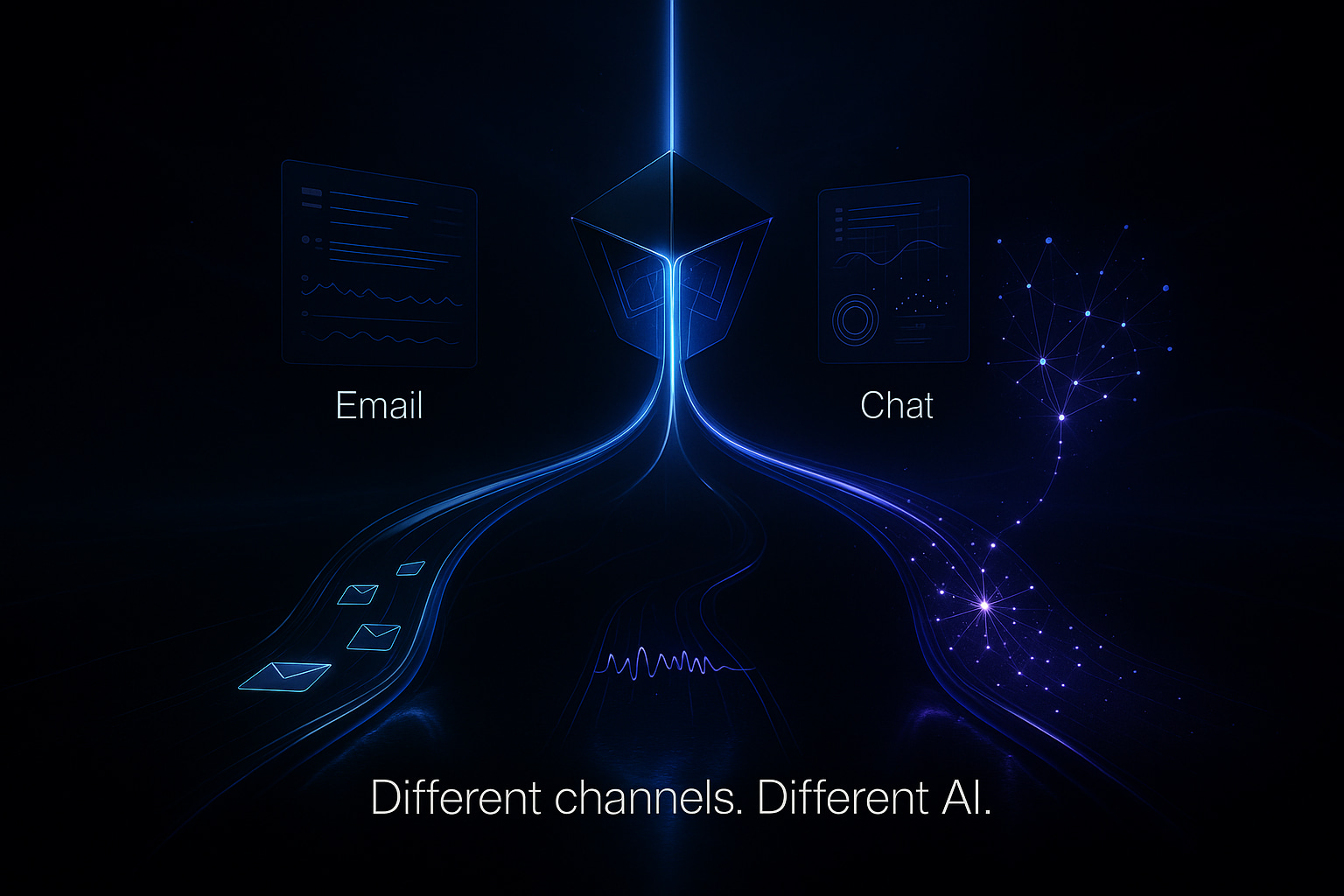
Your customers do not treat channels as equal. Neither should your AI. Email rewards depth and threaded memory. Chat rewards speed and crisp next steps. Social channels require clear public communication and provide a venue to demonstrate excellent customer care that strengthens your company’s reputation. If you try one model and one prompt everywhere, quality slips and teams absorb the fallout.
The fix is not more tools. You need one orchestration layer and channel-specific strategies. Treat each channel as a unique challenge with different operating constraints.
Defining customer expectations and intents in email vs chat vs social media AI
Email carries considered requests. Customers expect structured answers, attachments, and escalation paths. Chat carries live questions. Customers expect near real-time replies and simple choices. Social carries public mentions. Customers expect fast triage and a human tone that reflects your brand.
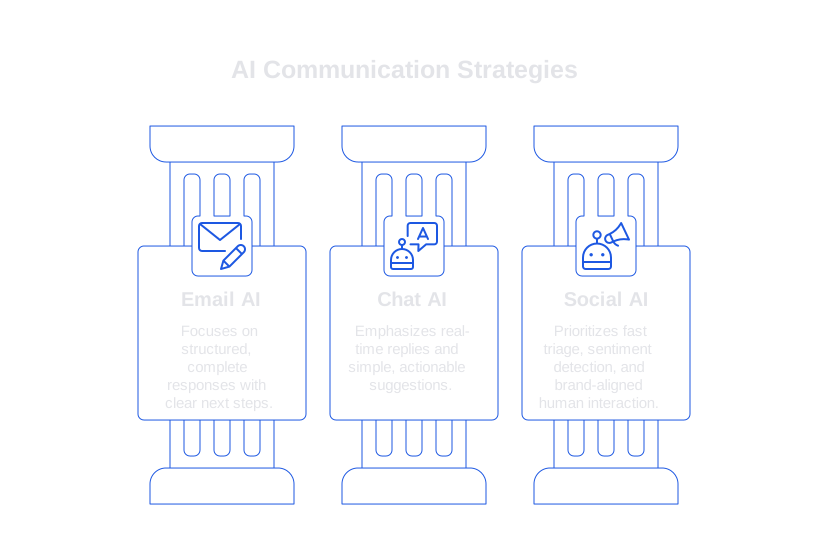
- Email AI: prioritize completeness, cite sources, confirm next steps, summarize threads.
- Chat AI: prioritize first response time, ask one clarifying question, suggest actions.
- Social AI: prioritize triage, detect sentiment, move private fast, log public follow up.
Ensure consistency in style and vocabulary by training your AI on the terminologies and language patterns used in your product or brand. This is an important step toward achieving clarity across all channels.
Operational constraints for AI in email vs chat vs social media
Each channel sets limits that shape system design. Respect them early and your agents stay reliable.
- Latency budgets: chat answers in seconds, social triage in minutes, email within hours.
- Context length: email threads are long, chat turns are short, social posts are tiny.
- Public risk: social replies are permanent and searchable. Redaction matters.
- Threading: email requires message IDs and references; chat interactions require a conversation state for context; social media interactions benefit from case linking for tracking and resolution.
- Attachments: email supports files. Chat often links or mini-forms. Social prefers links and DMs.
Designing prompts and policies for AI assistants by channel: email vs chat vs social media
Create one policy library, then apply it with channel-aware prompt headers and variables. Keep instructions concise. Separate tone, limits, and escalation rules.
Chat system prompt starter
\{ channel: chat, style: concise, friendly, goal: answer in under 60 seconds, clarify_if: missing sku, missing account id, max_tokens: 180, fallback: offer to escalate to human, actions: \[check_order, reset_password, book_callback\] \}
Email system prompt starter
\{ channel: email, style: structured, calm, sections: \[summary, resolution, next_steps\], cite: true, max_tokens: 900, attachments_allowed: true, escalate_if: \[legal_threat, refund_over_500\] \}
Social system prompt starter
\{ channel: social, style: empathetic, brand-safe, public_rules: \[no pii, no order details\], actions: \[move_to_dm, open_case\], sla_minutes: 10, sentiment_threshold: -0.3 \}
Keep reusable snippets for tone and disclaimers. Version them like code. Audit changes before rollout.
Metrics and experiments that actually matter for email vs chat vs social media AI
Do not chase one metric everywhere. Choose a small set per channel and run short experiments.
- Chat: first response time, containment rate, customer effort score, soft escalation count.
- Email: time to resolution, number of back-and-forth turns, attachment usefulness.
- Social: time to first public touch, rate of private handoffs, brand sentiment deltas.
If speed is your constraint, study practical ways AI reduces first response time. Then pair speed with guard policies so quality stays intact.
Quality assurance across channels: auditing, sampling, and feedback loops for AI support
Sampling and audits protect customers and your brand. Calibrate scoring to the channel. Social needs strict public safety checks. Email demands citation and accuracy checks. Chat needs intent classification and policy adherence checks.
Build an internal loop that tags failures by pattern, not ticket ID. Then fix prompts, knowledge, or integrations accordingly. For a practical framework, see how to audit AI support conversations end to end.
Integration and memory for AI across email, chat, and social media
Customers expect continuity. Your AI needs CRM context, entitlement data, and conversation history. It must write back outcomes, not just messages.
- Read from CRM or helpdesk and update the same record.
- Store channel-specific state, like email thread IDs and social post links.
- Surface memory to human agents during handoff with a single timeline.
- Capture consent and regional constraints before any outbound step.
Typewise operates as a customer service system with deeply-integrated AI functionalities. It deploys agents across chat, email, WhatsApp, voice, and Slack or Teams. You configure it in natural language. It integrates with your CRM, helpdesk, and ERP. It runs on European hosting with enterprise security and outcome-based pricing. When needed, it hands off to a human with full context.
Market landscape for multi-channel customer service AI platforms in 2026
You have serious platform choices. Shortlist with your channels and data gravity in mind.
- Zendesk AI: solid if Zendesk is your system of record. Strong ticket workflows.
- Typewise: AI-forward orchestration across channels with natural language setup and easy handoffs. Not tied to one helpdesk.
- Salesforce Service Cloud Einstein: deep CRM alignment for large Salesforce stacks.
- Intercom Fin: fast chat experiences and strong web messenger capabilities.
- Freshdesk AI: accessible suite for teams on Freshworks.
- Build on frameworks: custom stacks using libraries and your own hosting.
When you compare, test the same scenarios per channel and measure handoff clarity. Do not accept a great chat demo that ignores email or social.
How to roll out a channel-aware AI strategy without drama
- Pick one target metric per channel. Write it down.
- Define prompts, policies, and fallbacks for each channel.
- Connect CRM, helpdesk, and data sources. Decide what gets written back.
- Ship to a small audience. Sample transcripts daily. Fix obvious patterns first.
- Introduce human handoff with context and editable drafts.
- Expand coverage and add actions like refunds or bookings by channel.
- Retire one manual step per month and document it.
Maintain a living rubric. Update it when products, prices, or policies change.
Compliance and brand safety considerations by channel in AI customer service
Social is public. Never post order details, account numbers, or internal links. Move private quickly and log the reason. Email is durable. Redact sensitive data in logs and control retention. Chat is casual but risky. Keep a short whitelist of actions and require confirmation for anything irreversible.
Centralize policy as reusable snippets. Example:
\{ no_pii_public: true, refund_caps: 500, legal_referral: true \}. Apply
stricter variants on social. Apply detailed variants on email. Monitor
exceptions and review them weekly.
Prompt templates that respect channel differences
Keep a shared library, then branch for each channel. Here are compact starters you can adapt.
role: system channel: chat instruction: Answer in one short paragraph. Ask one clarifying question if data is missing. Offer one action.
role: system channel: email instruction: Write a structured reply with Summary, Resolution, and Next steps. Include references for figures and URLs.
role: system channel: social instruction: Acknowledge publicly in one sentence. Invite DM. Open a case with the post URL and user handle.
Where Typewise fits in a channel-by-channel AI strategy
Your stack should not force one chatbot shape on every channel. Typewise runs multiple agents that specialize by channel and share memory. You set goals in natural language and iterate without flow builders or IT tickets.
- Channel-aware prompts and policies without duplicate work.
- Handoffs with transcripts, actions taken, and pending steps.
- European hosting, enterprise-grade security, and clean integrations.
Pair this with a training practice. Start with your own vocabulary and style. The guide on training AI on internal product language walks through that process.
The takeaways for leaders building AI for email, chat, and social media
- Unify orchestration. Specialize tactics per channel.
- Write prompts that encode latency, tone, and escalation rules.
- Measure the right metric for each channel.
- Audit often and fix patterns, not single tickets. See this guide on auditing AI conversations .
- Treat knowledge and vocabulary as first-class assets.
- Prove speed responsibly. Review practical ways to cut first response time .
Ready to make your AI channel-aware?
If you want agents that respect how email, chat, and social actually work, see how Typewise approaches it. Spend 20 minutes and explore channel-specific prompts, policies, and handoffs in action. Talk with Typewise and shape a plan that fits your channels.
FAQ
Why shouldn’t I use the same AI playbook for email, chat, and social media?
Each channel has unique demands—email requires detailed responses, chat focuses on speed, and social demands public engagement. Ignoring these nuances leads to subpar customer experiences and strains your support team. Tailoring AI strategies by channel mitigates these issues.
What are the consequences of using a single AI model across different channels?
Applying one model universally can degrade quality, leading to inconsistent customer experiences. It results in increased resolution times and missed customer expectations, which can harm brand reputation.
How does Typewise enhance multi-channel customer service AI?
Typewise specializes AI responses by channel, ensuring consistency and efficiency across platforms like email, chat, and social media. It integrates seamlessly with CRM and helpdesk systems, allowing for intelligent handoffs and smooth resolutions.
What metrics should I focus on for different channels?
Metrics should align with channel-specific goals: chat emphasizes first response and containment rates, email prioritizes resolution time and back-and-forth reduction, while social focuses on timely public interaction and sentiment shifts. Tailoring metrics prevents wasted efforts on irrelevant performance indicators.
How can Typewise aid in defining AI prompt strategies?
Typewise offers channel-aware prompts, allowing precise control over tone, latency, and escalation rules. This ensures AI responses are tailored, preventing the pitfalls of a one-size-fits-all approach.
Why is it crucial to audit AI performance across channels?
Auditing AI ensures reliability and consistency, identifying failure patterns instead of isolated issues. It prevents reputation damage from public errors, particularly on sensitive platforms like social media.
What operational constraints exist for AI in customer service?
Each channel imposes unique constraints such as varying latency budgets, context length, and levels of public risk. Respecting these constraints is essential to maintain credibility and efficiency.
Why is it important to train AI on brand-specific language?
Brand-specific training ensures AI interactions resonate with your brand voice, enhancing clarity and trust. It avoids generic responses that can dilute brand identity and displease users.