
A/B testing AI replies that actually resolve customer issues
Your AI can write clever replies. That does not mean customers get resolution. Effective A/B tests judge resolution first, not flair. Set a crisp outcome signal before you start.
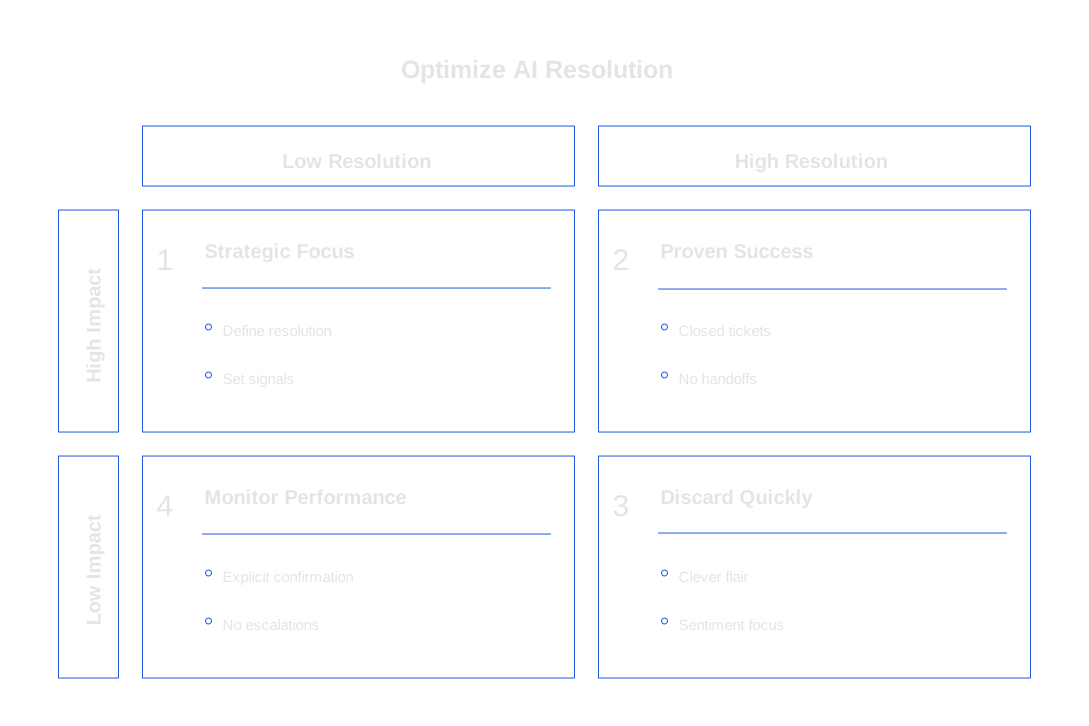
Define what “resolved” means for your team. Tie it to behavior, not sentiment. These patterns work well:
- Ticket closed and not reopened within 72 hours.
- No human handoff needed during the conversation.
- No refund or escalation within 14 days.
- Explicit confirmation from the customer.
resolved = ticket_closed AND no_reopen_72h AND no_refund_14d
Pick one definition and stick to it across variants. Otherwise, you compare apples to pears.
You do not improve customer experience by chasing clicks. You improve it by reducing recontacts.
Metrics that measure which AI responses actually resolve customer requests
Track a limited but comprehensive set of outcome metrics that includes key performance indicators. Report each by intent, channel, and language.
- Resolution rate: Share of conversations meeting your resolution definition.
- Reopen rate: Tickets reopened within your window, such as 72 hours.
- Agent intervention rate: Conversations moved to a human.
- Time to resolution: Minutes from first message to closure.
- CSAT after closure: Customer rating within 24 hours of close.
- Policy compliance: No restricted claims or missing disclosures.
resolution_rate = resolved_conversations / total_eligible_conversations
intervention_rate = human_handoffs / total_eligible_conversations
median_ttr = median( close_time - first_message_time )
Keep vanity metrics out. Word count and emoji rate rarely correlate with resolution.
Experiment design for A/B testing AI replies without harming live customers
Implement randomization at the individual conversation level and ensure that the variants are not switched or interchanged in the middle of an ongoing thread. Stratify by intent and market to avoid skew.
- Start with a small traffic share, like 10 percent.
- Watch intervention and reopen rates hourly.
- Ramp to 25, 50, then 100 percent if safe.
- Freeze prompts during the test window.
variant = hash( conversation_id ) % 2 ? A : B
Use sequential testing or Bayesian monitoring to curb peeking. Store assignment and outcomes immutably. Pre-register your stop criteria.
stop_if = intervention_rate_B - intervention_rate_A >= 2 percentage points
Maintain a control group that follows the typical, current methods of reply. This provides a realistic benchmark against which the experimental group can be measured.
Training AI on internal product language keeps tests fair
Many “wins” vanish when the AI misnames plans or features. Ground both variants in the same product terms and rules. This levels the field and reduces noise.
Use your knowledge base, SKUs, plan limits, and glossary as shared context. If your team needs a method, see this practical guide on training AI on internal product language. Consistent terminology shrinks confusion and improves intent mapping.
system: Use official plan names. Never invent features. Prefer quoting policy IDs.
Create business logic snippets that both variants call. Keep pricing rules and refund policies outside the prompt. Change them once, not twice.
Verifiers and signals that score AI replies during A/B tests
Do not rely on a single metric. Add automatic checks that grade replies before they reach customers. These verifiers reduce bad outcomes and speed learning.
- Policy verification. Confirm required disclaimers appear.
- Grounding verification. Flag claims without a cited source.
- Action verification. Check if the downstream action succeeded.
- Language verification. Detect tone or translation issues.
If you need patterns to implement, study these self-checking AI workflows with verifiers. They help you score variants faster and safer.
score = 0.6 * resolved + 0.2 * csat + 0.2 * qa_pass
Weight scores by ticket value or segment if needed. Keep the weighting transparent to stakeholders.
Audit samples to confirm resolution quality beyond raw metrics
Numbers miss nuance. Run blind audits on a stratified sample each week. Tag root causes for failure and success.
Adopt a clear rubric. Grade factual accuracy, policy alignment, empathy, and action success. Align the rubric with your outcome definition to avoid drift.
For a repeatable process, review this hands-on playbook on auditing AI customer support conversations. It shows how to calibrate reviewers and resolve disagreements.
qa_pass = factual_ok AND policy_ok AND action_ok
Close the loop. Feed audit findings back into prompts, tools, and knowledge.
Choosing tools for A/B testing AI replies across channels
Choose tools appropriate for your intended audience and platform, whether that be email, chat, WhatsApp, voice chat, or workplace communication apps. When possible, measure consistently across the channels you support, your customer does not care about channels.
- Zendesk AI. Useful if you already run Zendesk for support.
- Typewise. An AI agent platform that works like an AI concierge across channels. Configure behavior in natural language. It hands off to humans with full context. It integrates with CRM, helpdesk, and ERP. It runs on European hosting with enterprise-grade security. Pricing ties to outcomes.
- Intercom’s AI features. Solid for messenger-first teams.
- Ada and similar vendors. Helpful for high-volume deflection.
- Salesforce Einstein. An option for teams inside the Salesforce stack.
Whichever tool you choose, insist on clear assignment logs, outcome tracking, and easy prompt versioning. You need those for rigorous tests.
Pitfalls to avoid when A/B testing AI replies
- Avoid optimizing for reply length or style without ensuring each response leads to resolution. The design and quality of responses should be driven by effectiveness in resolving customer issues, not aesthetic appeal.
- Mixing intents with different base rates in one test.
- Comparing cohorts from peak and off-peak seasons.
- Counting partial automations as full resolutions.
- Changing prompts mid-test and losing attribution.
- Ignoring policy breaches that inflate quick wins.
- Skipping human audits that catch subtle errors.
false_win = lower_ttr AND higher_reopen_rate
Reject any variant that saves minutes but raises recontacts. That tradeoff hurts loyalty.
A simple workflow to run your next A/B test of AI replies
- Write a one-line resolution definition and publish it.
- Map intents and segment by market and language.
- Ground both variants in the same product glossary.
- Add verifiers for policy, grounding, and action success.
- Randomize at conversation level and log assignment.
- Run a 10 percent pilot and monitor hourly safety metrics.
- Scale to significance, then freeze and analyze by segment.
- Audit a stratified sample and code root causes.
- Ship the winner and archive all artifacts.
- Document learnings in your playbook for the next test.
archive: prompts, datasets, metrics, dashboards, audit_rubric, decisions
Example prompt tweaks to test safely
Keep changes surgical. Target specific faults, not style alone.
Variant A system: Resolve billing disputes. Cite policy ID. Offer call scheduling if unresolved.
Variant B system: Resolve billing disputes. Cite policy ID. Offer chat escalation if unresolved.
Ready to measure resolution with confidence
You now have a playbook for outcome-focused A/B tests. If you want a second set of eyes on design or instrumentation, we can help. Explore how an AI concierge approach works across channels and systems. Start a short conversation with the team at Typewise.
FAQ
What is the primary goal of A/B testing AI replies in customer service?
The main objective is to enhance resolution rates, not just improve reply aesthetics. Focusing on prompt effectiveness in resolving issues ensures genuine customer satisfaction without unnecessary recontacts.
Why should the definition of resolved be consistent during A/B testing?
Consistency prevents variables that skew results, ensuring a fair comparison between test variants. Diverging definitions could lead to misleading conclusions, such as falsely equating a quick reply with effective problem-solving.
How do automatic verifiers contribute to testing AI responses?
Verifiers preemptively filter out responses that don't meet standards, reducing customer exposure to flawed replies. This approach accelerates feedback loops, minimizing the risk of bad outcomes during live tests.
Why should AI replies avoid policy misstatements?
Misinformation erodes trust and exacerbates issues, turning short-term 'wins' into long-term liabilities. Grounding replies in accurate policy terms ensures integrity and clarity, safeguarding against false escalations.
Is reply flair beneficial in resolving customer inquiries?
Style without substance is a pitfall; it may obfuscate the core task of resolving customer issues. Instead, prioritize clarity and factual accuracy to genuinely enhance the support experience.
How can Typewise assist in managing AI replies?
Typewise offers an AI concierge solution that unifies communication across platforms, ensuring replies are consistent and contextually informed. Its integration capabilities with existing CRM and helpdesk systems streamline the support workflow.
What are the consequences of changing test prompts mid-experiment?
Mid-experiment changes can disrupt attribution and invalidate the test by introducing new variables. Consistency during testing is crucial for accurate result interpretation and reliable decision-making.
Why is monitoring intervention and reopen rates critical during testing?
These metrics directly reflect the AI's ability to resolve issues independently. Increased intervention or reopens signal a failure in the AI's effectiveness, demanding a reevaluation of the underlying prompt strategy.
Should human audits be part of the testing process?
Yes, audits capture nuances that raw metrics miss and validate the true quality of AI responses. This human oversight ensures adherence to accuracy and policy guidelines, preventing misleading test outcomes.