
"Resolution rate" is the number every customer-service AI reports and almost nobody defines. One tool counts a conversation as resolved when the AI sent a final message and the customer went quiet. Another counts it when the customer did not reopen the ticket within a day. A help desk counts the ticket closed when an agent closed it. Put those three numbers on one slide and you are comparing three different things.
This article is a measurement specification. It defines the events, the windows and the ledger you need so that "resolved" means the same thing in your business case, your vendor review and your quality audit. It is referenced by the business-case guide, which consumes these definitions rather than restating them. It does not describe any vendor's billing policy; if your contract charges per resolution, the contract's definition governs and should be compared against the one here.
Where this comes from. The specification comes out of four conversations Typewise held in 2026: a discovery conversation with an online retailer unhappy with how its incumbent tool counted resolutions, a discovery conversation with a travel company about its case logic, a demo a colleague ran for a retailer that compares reopen rates, and a pilot review with an online retailer running our agent. I was in three. Observations are anonymised and marked as reported; the definitions and the ledger are our recommendation, and the ledger numbers are invented.
Start from the case, not the message
The customer's unit is the case: the problem, from first contact to the point where nothing further is needed. Messages and tickets are how systems record it. A resolution is therefore an outcome at case level, and three things can go wrong between "message sent" and "case resolved":
- the customer comes back on the same problem (a reopen or repeat contact);
- a person had to finish part of the work (a partial handoff);
- the customer stopped replying because the answer was wrong and they gave up or went elsewhere (silence, which is not consent).
A specification handles all three explicitly.
The event definitions
| Event | Definition | Notes |
|---|---|---|
| Case opened | First inbound contact about a problem from a customer | A case is identified by customer and problem, and it persists until it is resolved; time alone never closes it |
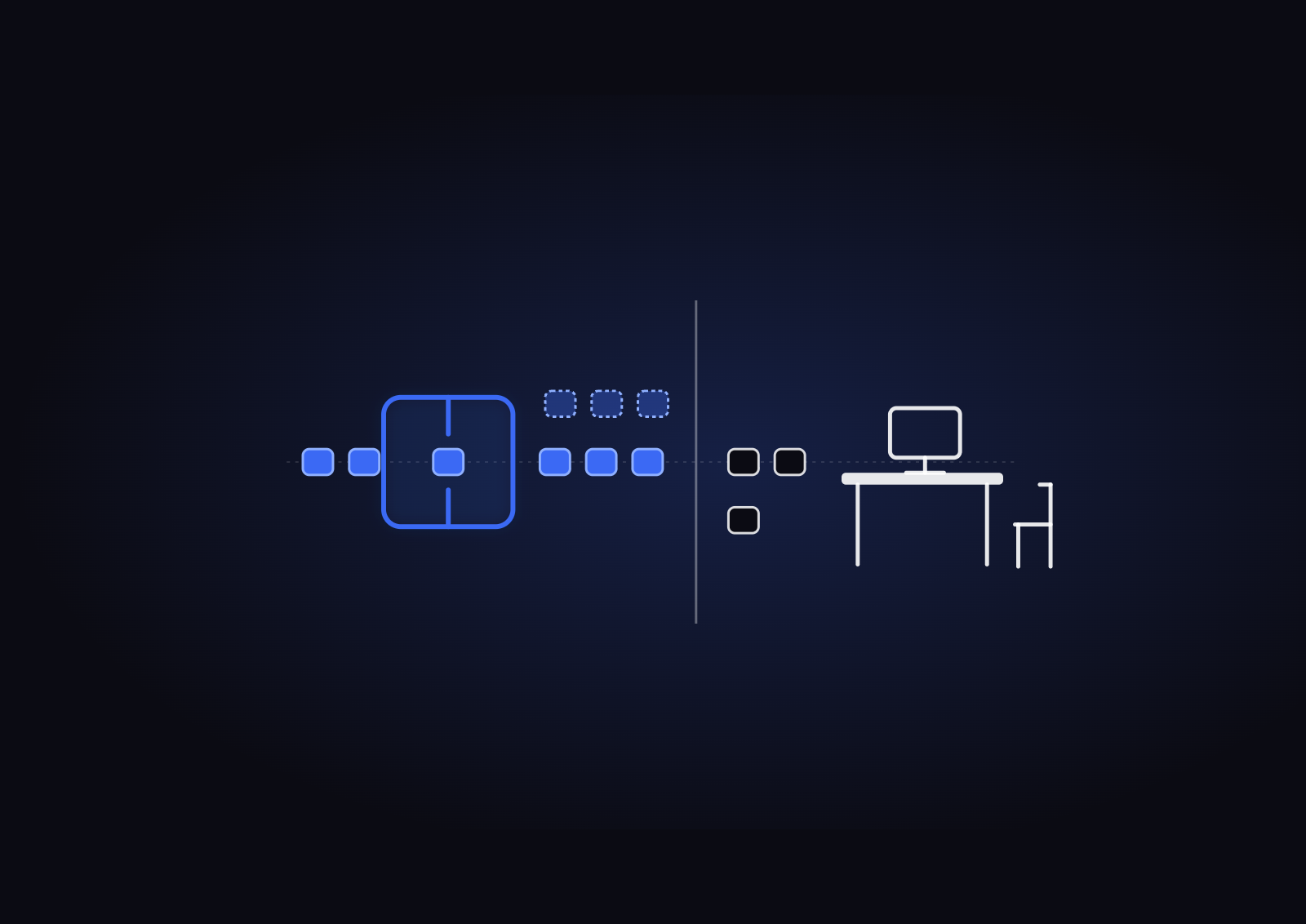
| Contact grouping (session) | Rapid repeat contacts from the same customer about the same problem are grouped into one contact for counting | A short window such as an hour is about counting contacts, not about case identity: a further contact about the same unresolved problem after the window still belongs to the same open case. A contact about an unrelated problem starts a new case immediately |
| AI-handled | The AI produced the customer-facing outcome without a person acting on the case | Drafts a person edited or released are assisted, not AI-handled |
| Partial handoff | A person performed at least one step (lookup, action, decision) before the outcome | Counted as human work in minutes, not as AI-handled |
| Candidate resolution | The case has a verified outcome (the system that performs the action confirms it) and no pending work on either side | Not yet "resolved"; the repeat-contact window has to pass. A case with an unconfirmed action or an open internal task is not a candidate |
| Repeat-contact window | The period after a candidate resolution during which a new contact about the same problem reopens the case | Choose per intent; see below. A contact about the same problem after the window has passed opens a new case that is linked to the earlier one, so the earlier resolution stands in its own period's ledger and the link is still visible |
| Reopen | A contact about the same problem, inside the repeat-contact window, on a case that had reached candidate resolution, on any channel | Only a provisionally closed case can reopen; a further contact on a still-open case is simply another contact on that case. Cross-channel contacts count; silence on the original channel is not resolution |
| Resolved | A candidate resolution whose repeat-contact window passed without a reopen | The only state that enters value calculations |
| Unknown (silent) | A case with no verified outcome where the customer simply stopped replying | Classified separately; absence of recontact alone is not proof of resolution. A sample is audited against evidence (delivery records, refund status, order data); audited cases move to resolved or known unresolved, the rest stay unknown. An audit checks evidence; it does not perform any work the customer still needs, and a case that needs human completion belongs in the human-assisted states |
| Business outcome | What the case was for: order delivered, refund issued, item added to basket, subscription retained | Tracked separately; a resolved case can still have a poor outcome |
Two choices need care.
Contact grouping versus case identity. A customer who sends five messages in an hour about one problem has made one contact about one case. Without grouping, the same problem becomes five tickets and the resolution rate is computed on inflated volume. The travel company's selection lead described their logic to me as grouping repeat contacts within an hour into one case and treating anything later as a separate case; the hour is a sensible counting rule, and that is all it should be. The grouping window is a counting rule, not a definition of the case: if the same customer comes back about the same still-open problem two days later, that is another contact on the same open case, not a new case and not a reopen. A reopen is only possible once the case had reached candidate resolution and the contact falls inside the repeat-contact window. If the same problem comes back after that window has passed, open a new case linked to the earlier one; the earlier resolution stands in its own period's ledger and the link is reported, so time never silently manufactures a fresh, unconnected case. Only a genuinely different problem starts a new case straight away. Keep the case identity persistent by customer and problem, document the contact-grouping window separately, and keep the full customer history visible regardless.
The repeat-contact window. Delivery questions are typically answered within days; a return or refund may take two weeks to prove itself; a subscription change may not show until the next invoice. Set the window per intent based on how long it takes for the answer to be tested by reality. A single global window is simpler and wrong for at least one of your intents.
Why silence is not resolution
A case where the customer stops replying has one of three explanations: the answer worked, the customer gave up, or the customer tried another channel. Tools that count silence as resolution report the first and hide the other two. Silent cases without a verified outcome belong in their own "unknown" state; they are neither resolved nor reopened until a check establishes which. Two checks expose the difference:
- Cross-channel reopens. Match contacts by customer and problem across chat, email, phone and messaging. A case "resolved" in chat and reopened by email the next day is a reopen.
- Outcome sampling. For a sample of silent cases, check what happened next: was the order delivered, was the return accepted, did the customer buy. The online retailer's founder described what he found when reviewing tickets his incumbent tool had marked resolved: the tool reported a resolution rate on the chats it handled, but customers in countries their return portal did not serve had been sent to that portal anyway. They did not argue; they stopped replying and tried another channel, and the dashboard called it success.
For pre-sales conversations, define the success event as the thing the customer was trying to do (an item added, an order completed) rather than the conversation ending.
Two bounds follow. Reopens observed on one channel are a lower bound on true reopens, because reopens on other channels are missed. A resolution rate that treats unverified silent cases as resolved is an upper bound on true resolution. Report both bounds when the data does not allow a point estimate.
The ledger: a worked, hypothetical month
Invented numbers to show how the events combine. The point is the structure, not the values. The ledger has two parts that must not be mixed: the cohorts, which split the month's cases by who handled them and sum to the total, and the outcomes, which split one cohort by what happened to it at a single observation cutoff (here: the end of the month plus the longest repeat-contact window) and sum to that cohort. Rates are always a numerator from the outcome rows over a denominator that is a named cohort.
| Line | Count | How it is derived |
|---|---|---|
| Cohorts (sum to 4,000) | Cases opened in the month: 5,600 contacts; rapid repeats grouped within the one-hour contact window; later contacts about a still-open problem attached to the open case | |
| Fully human | 1,600 | Routed or handed off before any AI outcome |
| Partial handoffs | 500 | A person did at least one step; 2,100 human minutes recorded |
| AI-handled | 1,900 | No person acted on the case. Of these, 1,600 reached a verified candidate resolution (outcome confirmed by the performing system, no pending work) and 300 went silent with no verified outcome |
| Outcomes of the 1,900 AI-handled cases at the cutoff (sum to 1,900) | Each case is in exactly one row | |
| Resolved | 1,400 | 1,360 verified candidates whose window passed without a reopen (1,600 − 240), plus 40 of the 300 silent cases whose audit confirmed a verified outcome, no pending work and a matured window under the same criteria |
| Known unresolved | 260 | 240 verified candidates reopened inside the window (including 60 reopens found on other channels) plus 20 silent cases whose audit showed the problem was not solved; none of the 20 had received human work by the cutoff, and any that a person later completes move to the human-assisted states in that period |
| Unknown | 240 | 300 silent cases minus the 60 audited; not extrapolated from the audit, simply unknown |
| Rates | Numerator over a named denominator, unrounded then rounded | |
| AI resolution, share of all cases | 35.0% to 41.0% | Lower bound 1,400 / 4,000 = 0.350; upper bound (1,400 + 240 unknown) / 4,000 = 1,640 / 4,000 = 0.410 |
| AI resolution, share of AI-handled cases | 73.7% to 86.3% | Lower bound 1,400 / 1,900 = 0.7368; upper bound 1,640 / 1,900 = 0.8632 |
| Resolution among verified candidates only (conditional metric) | 85.0% | 1,360 / 1,600 = 0.850. This describes reliability where the AI reached a verified outcome; it is not the AI-handled success rate, because it excludes the 300 silent cases |
| Observed reopen rate, single channel versus all channels | 11.3% versus 15.0% of verified candidates | With single-channel matching only 180 of the 240 reopens are seen: 180 / 1,600 = 0.1125, a lower bound; all channels 240 / 1,600 = 0.150 |
| Human reopen rate, same window | for comparison | Computed identically on the 1,600 fully human cases, with the same window and grouping |
The numbers are invented and do not add up to a benchmark; the point is the structure. Notice the two interval rates. Both are honest; they answer different questions. The first is what the business case needs (how much of all demand the AI finished). The second is what the quality review needs (how reliable the AI is where it acts). The conditional 85% is a third thing again: useful for diagnosing the verified cases, misleading if presented as the AI-handled success rate. A vendor dashboard that shows only a figure like the conditional one, on a denominator of conversations the AI touched, will look better than the first two and is not comparable to a help desk's number.
Also notice the comparison line. Reopen rates for AI-handled and human-handled cases are only comparable with the same window, the same grouping and a similar case mix. If the comparison shows AI-handled cases reopening at a materially higher rate than human-handled ones, treat that as a finding to act on through the fact and relevance edits described in what agents change in AI-written replies, not as a reason to change the definition. The retailer in the demo had run such a comparison and found reopen rates for AI-handled tickets noticeably higher than for human-only tickets; not all of the reopened tickets had been analysed yet and comparability was not established. Until it is, treat such a gap as a prompt to align windows and grouping and to trace causes, not as a result.
Partial handoffs are human work
One way a resolution rate flatters is by counting a case as AI-handled when a person did a step in the middle. Record the human minutes on partial handoffs and report them next to the resolution rate; a high "AI participation" figure with a high partial share is a different operation from one where the AI finishes cases alone. In the pilot review, the retailer's service director said a high share of conversations handled by the AI looked positive but the share that was only partially resolved was a bone of contention, and their engineering lead planned to review how many conversations the AI ran alone, how many agents replied to, and how much involvement was needed, before deciding anything. That is the right order. For how to design the partial step so it is at least visible, see handoff ownership.
Specification checklist
Before you compare any two resolution numbers, or put one in a business case, confirm:
- [ ] Unit is the case, identified by customer and problem and persistent until resolved; the contact-grouping window is documented separately and never closes a case; a further contact on an open case is not a reopen; the same problem after the window opens a new, linked case.
- [ ] One observation cutoff per ledger; cohorts sum to the total and outcomes sum to their cohort; every case is in exactly one final state.
- [ ] Candidate resolution requires a verified outcome and no pending work.
- [ ] AI-handled, assisted, partial handoff and fully human are distinct states.
- [ ] Repeat-contact window set per intent and documented.
- [ ] Reopens matched across channels, by customer and problem.
- [ ] Silence is not a resolution event; silent cases without a verified outcome are classified as unknown; audited cases move to resolved or known unresolved on evidence, the rest stay unknown and are not extrapolated.
- [ ] Two rates reported: of all cases and of AI-handled cases, with denominators shown, and with lower and upper bounds where channels are missing or unknown cases remain.
- [ ] Human reopen rate computed with identical rules for comparison.
- [ ] Human minutes on partial handoffs recorded.
- [ ] Business outcome tracked separately from resolution.
- [ ] Any contractual resolution definition compared against this one, differences listed.
Limits
The specification needs cross-channel customer matching, which some help desks do not provide; where it is missing, report that reopens are measured on one channel, treat the observed reopen rate as a lower bound and the inferred resolution rate as an upper bound. Repeat-contact windows are judgement calls; the goal is consistency over time, not a perfect value. And a resolved case is not a good outcome by definition; keep the business outcome in view.
Related reading
- Building a defensible business case for customer-service AI: where these definitions enter the money.
- First contact resolution: the essential customer success KPI: the human-side metric with its own rules for reopens and transfers.
- Top 10 metrics to track for AI-powered customer success: the wider measurement set.
FAQ
Our AI tool reports a resolution rate. Can we use it directly?
Only once you know its definition: what counts as handled, whether silence counts as resolved, what the repeat-contact window is, and what the denominator is. Most tools report a rate on conversations the AI touched, which is not comparable to a rate on all cases.
How long should the repeat-contact window be?
Long enough for the answer to be tested by reality, which differs by intent: days for delivery questions, longer for returns and refunds, until the next invoice for subscription changes. Set it per intent and keep it consistent over time. The window is distinct from the short contact-grouping window, and neither closes an unresolved case on its own; the same problem returning after the window opens a new case linked to the earlier one.
Is a case where a person did one step AI-handled?
No. It is a partial handoff. Record the human minutes and report the partial share next to the resolution rate, so that AI participation and AI resolution are not confused.