
Build vs. Buy for AI Agents: The Hidden Costs That Surface After Launch
As of the time this article was written, AI agents feel within reach. Creating a basic prototype can take just a few days. However, running an AI agent at scale is an entirely different challenge. The space between an impressive demo and a fully-functioning production system contains real, often hidden costs, costs you’ll only encounter if you decide to build your own solution.
These hidden costs come from multiple directions: some are technical, others organizational.
- Model drift and prompt decay increase ongoing maintenance workloads.
- APIs evolve. Permissions and quotas for third-party tools may change unexpectedly.
- Evaluation pipelines, test data, and accurate labels require constant upkeep.
- Security reviews introduce additional cycles into every new feature launch.
- Incident response, for incorrect or unsafe outputs, demands a reliable playbook.
- Context ingestion needs expand with your product, documentation, and support tickets.
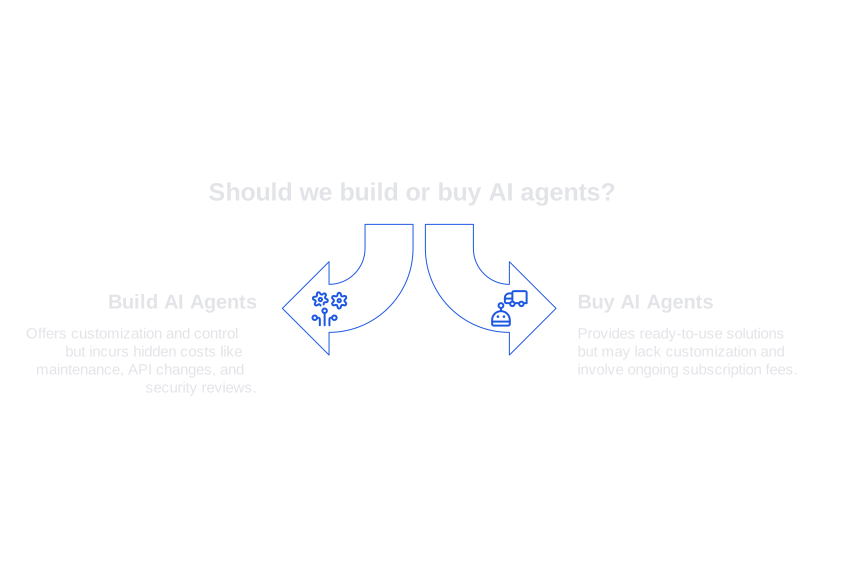
Choosing a platform typically bundles many of these expenses into a predictable subscription fee. Opting to build keeps you in full command, but it also keeps the responsibility and burden of reliability on your shoulders. Which path is right depends on your risk appetite, internal capabilities, and development timelines.
Evaluating AI Agent Architecture for Build vs. Buy Decisions: Orchestration, Data, and Observability
Start by outlining the architecture needed for your AI agent. Comprehensive AI agent systems commonly require elements such as tool utilization, data retrieval, memory allocation, and periodic policy checks. Observability, replay functionality, and safe fallback mechanisms are also essential for production-level performance and trust.
Building from scratch means carefully selecting models, designing effective prompts, and wiring the necessary tools. You’ll manage retrieval pipelines, build embeddings, chunk and rank data, and set up evaluators with confidence thresholds. You also need to ensure rollbacks and versioning are robust and easy to manage. In contrast, buying a platform abstracts much of this complexity and provides user-friendly controls.
The structure of prompts, along with precise thresholds and clear actions, play critical roles. Defining a compact prompt specification can clarify both custom-built and platform-based configurations. For example:
role: system | product: ACME Router | tone: clear | tools: \{ search_kb , create_ticket , refund \} | fallback_threshold: 0.65 | citation: required
Whether assembling components independently or leveraging a platform, require traceable runs. Every conversation should be replayable, with inputs and actions fully auditable. Without this level of observability, it’s impossible to debug regressions or easily train new model versions.
Security and Compliance for AI Agents in a Build vs. Buy Decision
Handling customer data demands strict safeguards. AI agents will inevitably process personally identifiable information (PII), contract details, and account identifiers, making encryption, access controls, and thorough audit logs essential.
Ensure the basics: Single sign-on (SSO) and role-based access control, data retention policies, PII redaction for both storage and prompt content, regional data residency compliance, vendor subprocessors, and transparent incident reporting procedures.
Ship fast, but never ship customer data you cannot trace.
If you build, you will need to implement and document all these controls yourself. In the buy scenario, confirm that the provider’s guarantees and certifications, such as SOC 2, ISO 27001, and GDPR, meet your requirements. Make sure customer data is isolated, ask specifically who can access prompts and outputs, and weigh security posture as heavily as core features.
Integration Realities for AI Agents in CRM, Email, and Chat Systems During a Build vs. Buy Choice
Your AI agent must work natively where your teams do, which typically involves integrating deeply with CRM records, email threads, chat logs, and support ticket fields. The quality of these integrations directly affects adoption and user experience.
Building your own connectors means handling every detail: pagination, rate limits, error retries, idempotency, field mapping, custom object handling, and alignment with automation flows. This significant effort requires ongoing commitment as systems change.
Platforms like Typewise integrate directly into established workflows, CRM, email, and chat, keeping your team firmly within familiar tools. These platforms also help your agents communicate in your brand’s distinct tone and adhere to policy, while reducing context switching for faster, more consistent replies.
Quality, Brand Voice, and Safety for AI Agents in a Build vs. Buy Context
AI agents build trust by communicating in your voice and consistently following company policies. Achieving this requires structured domain knowledge, common vocabulary, and built-in safety checks.
- Maintain a centralized glossary for product vocabulary and abbreviations.
- Encode brand tone and style into reusable instruction sets.
- Gate potentially risky outputs through automated verifiers before releasing messages.
- Audit conversations regularly to improve systems, not to assign blame.
If you need to establish standardized terminology, learn more about how to train AI on your internal product language. Properly defining terminology reduces misinterpretations and vague responses.
For safety, use structured verifiers to flag speculative or incorrect answers early. You can add verifiers to catch bad support answers and escalate low-confidence cases to human support agents.
Quality management is a continuous process. Teams should log, label, and regularly review agent interactions. For more on building a review culture, see how to audit AI customer support conversations and turn errors into better prompts, datasets, and operational policies.
A Pragmatic Scoring Model for Deciding to Build AI Agents or Adopt a Platform
Establish a straightforward evaluation rubric. Score each dimension from 1 to 5, where a higher score signals a stronger need to build:
- Control and differentiation: Does custom behavior drive your core value?
- Speed and resources: Can you sustain an in-house AI and platform team?
- Security requirements: Are your needs for data isolation or deployment non-standard?
- Integration complexity: Do you require deep, two-way synchronization with many systems?
- Change rate: How frequently do your products, prices, or policies change?
- Total cost of ownership: Are you prepared for the long-term operational overhead?
Tally your scores. A low total typically indicates that buying an established solution is a better fit. A high total suggests that building may provide significant advantages. In practice, many teams favor a hybrid model, purchasing a robust platform while extending it with custom components for areas of greatest value.
The AI Agent Platform Landscape for Customer Support: Typewise and Its Peers
The market for AI agents can be categorized into three distinct groups, each serving a different need:
- CRM-native suites. Major CRM vendors offer tightly integrated agents that work directly within established case management flows. These solutions fit teams deeply embedded in a single ecosystem and comfortable with its native pace of innovation.
- Typewise and other AI-first platforms. Typewise focuses on enterprise writing assistance for customer service and business communications. It integrates with CRM, email, and chat tools, ensuring replies are accurate, prompt, and consistent in brand voice. Typewise also brings robust privacy controls expected by larger organizations.
- Developer frameworks and toolkits. These provide maximum flexibility for engineering teams who want to build orchestration and evaluation pipelines from individual parts, maintaining complete technical ownership.
When assessing the landscape, rank your options according to your specific requirements, not industry headlines. Investigate each for integration depth, data security, and observability. Scrutinize licensing and data handling. Whenever possible, run equivalent pilot projects with shortlisted vendors so results are genuinely comparable.
Run a Focused Pilot to Validate Your AI Agents Before a Final Build vs. Buy Decision
Pilot programs, small-scale, manageable implementations of an AI strategy, are an excellent way to cut through subjective opinions and ground your decision in data.
- Select five well-defined use cases (“intents”); ensure at least one involves a refund and another an account update.
- Prepare reference data: include policy snippets, price lists, and product specifications.
- Define objective metrics, such as first response time, resolution rate, re-open counts, and any legal compliance flags.
- Establish fail-safes, like confidence score thresholds and automated routing of unclear cases to human agents.
- Instrument logs: sample transcripts and review labeled outcomes weekly.
- Hold a review session to compare the quality, effort, and risk of change between your build and buy options.
Document both the upfront and operational costs of your pilot, including on-call needs, security evaluations, and retraining cycles. Your decision memo should reflect technical performance and the full burden of ongoing maintenance.
Conclusion on Build vs. Buy for AI Agents and a Next Step
Opting to build your own AI agents provides more control over the development and implementation process. On the other hand, purchasing a ready-made platform can offer the benefits of faster deployment and steady, reliable operations. Most organizations mix approaches, focusing engineering effort on elements where control and differentiation matter most, while relying on trusted platforms for everything else.
If you’re seeking a privacy-focused platform that integrates seamlessly with your CRM, email, and chat tools, consider a short pilot with Typewise. Start a conversation at typewise.app to see how your workflows can translate into dependable, efficient AI assistance.
FAQ
What are the hidden costs of building an AI agent from scratch?
Building an AI agent involves unforeseen expenses like model maintenance, evolving APIs, and complex security reviews. These factors can significantly inflate the costs and effort required to sustain reliable operations.
Why should prompt structure be a priority in AI agent development?
Accurate prompts are crucial as they dictate the AI's responses and effectiveness. An error in prompt design can lead to misinterpretations and unreliable outputs, compromising the agent’s consistency and trustworthiness.
How do security and compliance impact AI agent decisions?
AI systems handling PII require rigorous security controls like encryption and audits. Non-compliance with security standards increases the risk of data breaches, making robust security measures non-negotiable.
When is it advisable to choose a platform like Typewise over building your own AI solution?
If you value quick deployment, consistent branding, and comprehensive privacy controls, a platform like Typewise is advantageous. It abstracts the complexity and reduces the burden of in-house maintenance.
What is the main advantage of running a pilot project before a full-scale AI deployment?
Pilots provide empirical data on performance and cost, allowing for an informed buy vs. build decision. Skipping this step risks committing to a solution that fails to meet operational or strategic goals.
How do integrations affect AI agent effectiveness?
Poorly integrated AI agents disrupt workflows and user efficiency. Seamless integration, as seen with Typewise, ensures that AI agents enhance rather than hinder productivity.
What factors might lead to a decision to build an AI solution?
Building an AI solution may be necessary when unique functionalities align with core business needs, or when off-the-shelf solutions don't offer the required adaptability or control.
What role does observability play in AI agent management?
Observability ensures every interaction can be traced and audited, vital for debugging and improving agent performance. Without it, systematic issues remain hidden, leading to potential failure in operations.
How does Typewise ensure brand consistency in AI communications?
Typewise leverages predefined instruction sets and glossary terms to mirror your brand's voice in customer interactions. This maintains brand reliability, helping to build customer trust and loyalty.