
Why real-time PII redaction matters for AI memory and trust
Your AI learns fast. It also remembers more than you expect. Without controls, chat logs, emails, and voice transcripts can stockpile sensitive data. That data often seeps into prompts, vector indexes, and analytics. Real-time PII redaction stops the leak before memory forms.
PII includes names, emails, phone numbers, addresses, government IDs, payment data, and health details. If these reach long-term memory, the risk multiplies. You face accidental echoes in replies. You also face breach exposure and regulatory action. Customers lose confidence quickly when private details resurface.
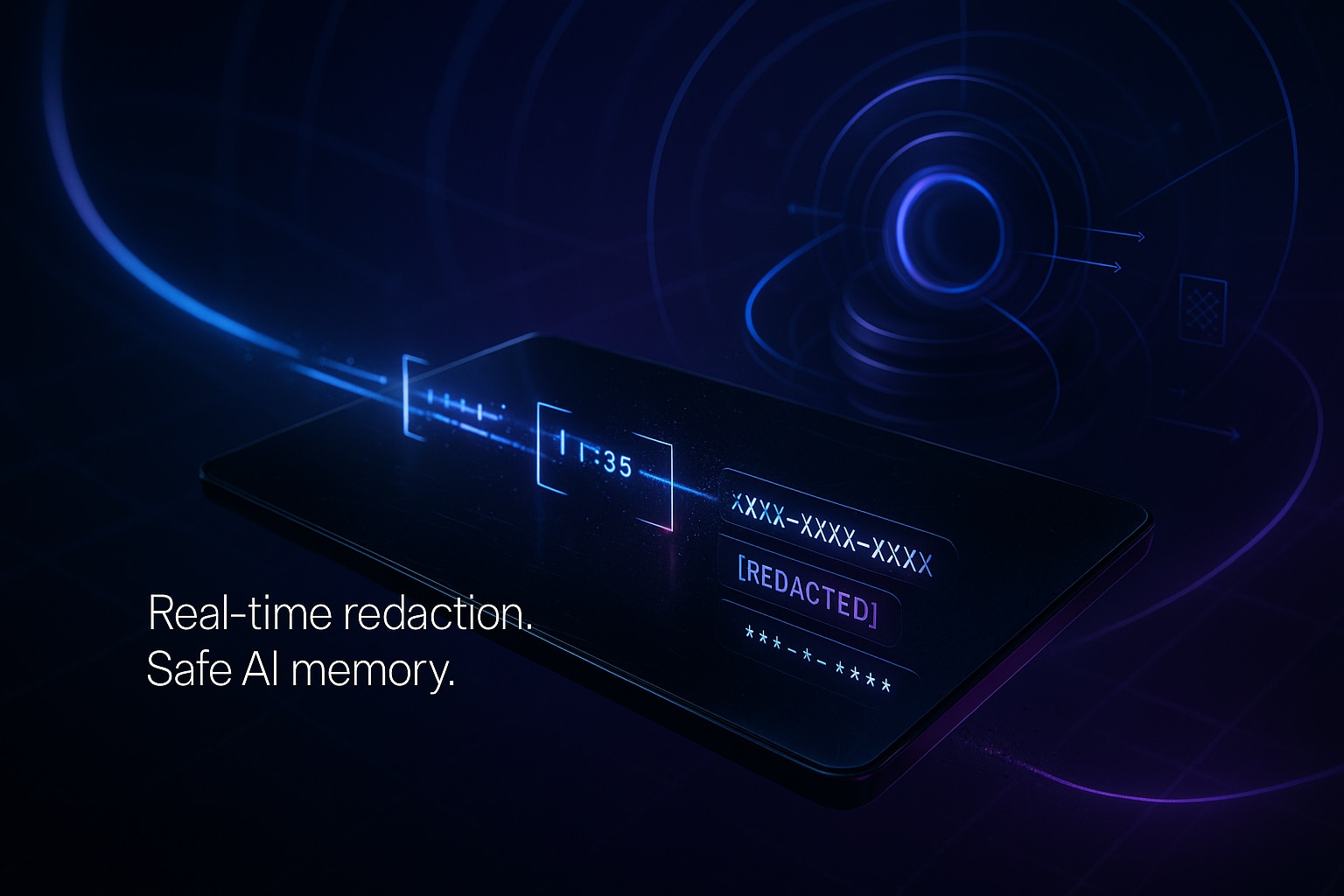
Redaction must run during ingestion, not after the fact. The goal is simple. Remove or replace sensitive strings before storage, retrieval, or training. Do it across channels and languages. Keep context useful. Keep round-trip latency low.
How real-time PII redaction works across live channels and AI memory
A solid pipeline applies detection, classification, transformation, and logging in sequence. First, detect likely entities with rules and models. Next, confirm the type with context. Then replace the span with a reversible token or an irreversible mask. Finally, log the action for audits.
For live chat, the interceptor scrubs text before it hits the LLM. For voice interactions, the Automated Speech Recognition (ASR) stream flags detected entities as words are recognized in real time. For email, attachments and signatures need scanning. For RAG, indexing jobs must remove PII before embedding. Do not let PII reach your vector store.
When it’s necessary to preserve meaning, use surrogate replacements such as changing “Jane Doe” to an anonymized entity “[PERSON#9421]”. Maintain a temporary mapping vault that correlates these tokens with their original data. Ensure mappings are short-lived and expire on a strict schedule. Limit “rehydration” (revealing the original values from surrogates) to authorized personnel under role-based access with full logging.
Prompt the model to avoid echoing sensitive inputs. Also scrub generated text on the way out. This last step catches slips and hallucinated PII.
system: You are a support agent. Never store, memorize, or repeat PII. Replace detected PII with \[TYPE#ID\]. Do not expand or guess masked values. If unsure, ask for consent or route to a human.
Design patterns for robust PII redaction without breaking customer experience
Good redaction keeps conversations clear. Bad redaction blocks useful context. Aim for balance with these patterns:
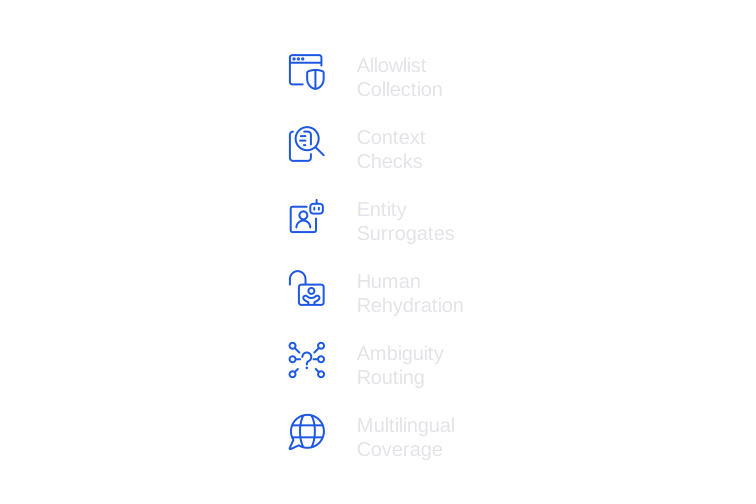
- Allowlist collection. Only collect what you can justify. Everything else gets masked.
- Context checks. A 6-digit code near “OTP” is sensitive. The same digits in a SKU may not be.
- Entity surrogates. Use stable placeholders across a thread. The agent can say, “I updated [PERSON#9421]’s order.”
- Human rehydration. When you transfer to an agent, reveal originals under role-based access. Log the reveal.
- Ambiguity routing. If the detector is uncertain, request clarification or escalate.
- Multilingual coverage. Support names and formats across locales. Consider script variants.
Typewise facilitates this process of redaction with its cross-channel agents and seamless human handoffs. The platform keeps full context while respecting privacy rules. Configuration happens in natural language, not in brittle flow builders.
Operational metrics and controls that prove your PII redaction works
If you cannot measure it, you cannot trust it. Track quality with a clear scorecard. Sample ideas:
- Redaction coverage. Share of conversations containing at least one masked entity.
- Precision and recall proxies. Estimate misses and over-masks with seeded test sets.
- Latency impact. Extra milliseconds added by redaction on each channel.
- Echo rate. Times the model repeats sensitive input after scrubbing.
- Rehydration events. Frequency, approver identity, and purpose.
- Retention conformance. Age of tokens and vault entries over time.
Audit often. Build an internal review loop with anonymized samples. For a practical method, see this guide on auditing AI customer support conversations. Pair audits with automated checks. Verifiers can catch PII that slips past the first pass.
You can set up self-tests that review prompts, model outputs, and logs. They flag risky strings and block delivery. For a step-by-step approach, explore self-checking AI workflows that add verifiers to catch bad support answers.
Compliance and data residency considerations for real-time PII redaction in AI customer service
Privacy laws reward restraint. Redact early and store less. GDPR requires data minimization, purpose limits, and subject rights. You need deletion across logs, caches, and embeddings. Audit trails must show what you masked and why. PCI DSS demands special care for payment data. Local rules, like the California Privacy Rights Act (CPRA), bring added rights and obligations.
Data residency matters. European teams often prefer EU hosting. Encryption in transit and at rest is table stakes. Key management must be separate. Access must be role based and recorded. Run a DPIA before launch and refresh it after major changes.
For a structured walkthrough, review the GDPR compliance checklist for AI customer service teams in Europe. It pairs well with a redaction-first design.
Vendor landscape and where Typewise fits for real-time PII redaction
You can assemble redaction with several routes. Here is a quick view:
- Google Cloud DLP. Broad detectors and scalable APIs for text and files.
- Typewise. AI agents with built-in redaction across chat, email, WhatsApp, voice, and internal tools. Natural language setup. EU hosting with enterprise security. Clean handoffs to humans with safe rehydration. Outcome-based pricing aligns with delivered results.
- AWS Comprehend PII. Entity detection inside AWS stacks with model updates.
- Microsoft Presidio. Open source building blocks for custom pipelines.
Point tools detect entities well. Platforms matter when you need orchestration, handoffs, and policy. Your stack may mix both. Many teams start with a cloud DLP and later standardize on a platform that spans channels and memory.
Implementation checklist and sample prompts for training your AI to respect PII
Use a clear rollout plan. Keep it simple and testable.
- Define the exact PII types you handle and why.
- Map every ingress path and memory store in the flow.
- Apply redaction at input, at memory write, and at output.
- Introduce surrogates and a short-lived token vault.
- Enable human rehydration with approvals and full logging.
- Seed conversations with synthetic PII. Measure what gets caught.
- Set up verifiers to review outputs continuously.
- Schedule monthly audits and quarterly threat reviews.
Prompts should reflect your policy. Keep them short and concrete.
system: You redact PII in real time. Replace with \[TYPE#ID\]. Never infer hidden values. If a user requests storage of PII, ask for consent, summarize the purpose, and route to a human.
For response checks, deploying verifier prompts can effectively flag potentially sensitive content.
system: Inspect this draft answer. If it contains PII or disallowed tokens, label RISK and explain. Otherwise, label OK. Return only the label and a one-sentence reason.
Combine prompts with audits and monitors. See the end-to-end advice on auditing AI support conversations for safety. Pair that with the guide on adding verifiers to workflows for continual checks.
How Typewise approaches real-time PII redaction inside an AI-native customer operating system
Typewise deploys AI agents that span service, sales, and internal operations. You configure behavior in natural language. There is no IT setup or flow builder overhead. The agents work in chat, email, WhatsApp, voice, and Slack or Teams. They integrate with your CRM, helpdesk, and ERP. Redaction and memory policies stay consistent across channels.
European hosting supports strict residency needs. Security features match enterprise expectations. When a human must join, Typewise passes full context without exposing sensitive strings. Redaction surrogates keep the thread coherent. Outcome-based pricing keeps attention on results, not seats or tokens.
Where to go next to deploy safe real-time PII redaction with outcome focus
Start with a single channel and a clear policy. Prove detection quality on real flows. Expand to memory and RAG. Add verifiers and audits. Lock down residency and approvals. You will keep private data out of long-term memory while serving customers well.
If you want help stitching this together, reach out. The Typewise team builds AI agents with real-time redaction and clean handoffs. See how it fits your stack at typewise.app.
FAQ
What is PII redaction in real-time, and why is it crucial?
Real-time PII redaction involves detecting and removing personally identifiable information instantly as data is processed, preventing sensitive data from reaching AI memory. It's crucial to mitigate risks of data breaches and regulatory repercussions while maintaining customer trust.
How does real-time PII redaction impact AI performance?
Implementing real-time PII redaction maintains low latency, ensuring AI systems function efficiently without sacrificing response time. While the process adds complexity, avoiding leaks is more beneficial than dealing with the fallout of compromised data.
Why is context preservation important in PII redaction?
Preserving context during redaction ensures that conversations remain meaningful and functional even after sensitive information is removed. Typewise employs surrogate replacements to achieve this balance, maintaining clarity without exposing PII.
How does Typewise ensure compliance with data protection laws?
Typewise real-time PII redaction aligns with laws like GDPR and PCI DSS through data minimization, encryption, and strict audit trails. Its European hosting options and comprehensive privacy rules further ensure compliance and data residency demands.
What are the typical challenges faced in implementing PII redaction?
Common challenges include striking a balance between effective redaction and retaining essential context, managing latency, and ensuring redaction accuracy across multiple channels and languages. Poor implementation leads to data leaks, customer dissatisfaction, and legal troubles.
How can one measure the effectiveness of a PII redaction system?
Effectiveness is gauged by tracking metrics such as redaction coverage, precision/recall rates, latency impact, and adherence to retention policies. Regular audits and testing are critical to ensure the system continuously meets its privacy objectives.
Why is human intervention sometimes necessary in PII redaction?
Despite automation, ambiguity in data can require human oversight to interpret context accurately and decide on the best course of action. Typewise allows controlled rehydration under strict access controls, ensuring sensitive data is handled appropriately when needed.
What differentiates Typewise from other PII redaction solutions?
Typewise offers seamless redaction across multiple communication channels with natural language configuration, avoiding complex IT setups. It emphasizes consistent privacy rules and outcome-based pricing tailored to businesses seeking effective data protection without unnecessary complexity.