
SOC 2 vs ISO 27001 for your support stack: reading the labels that actually matter
Your support stack handles sensitive conversations, identities, and purchase data. Two labels show up in nearly every vendor deck: SOC 2 and ISO 27001. They sound similar. They are not. Understanding the difference helps you buy safer tools, operate with fewer surprises, and pass audits without firefighting.
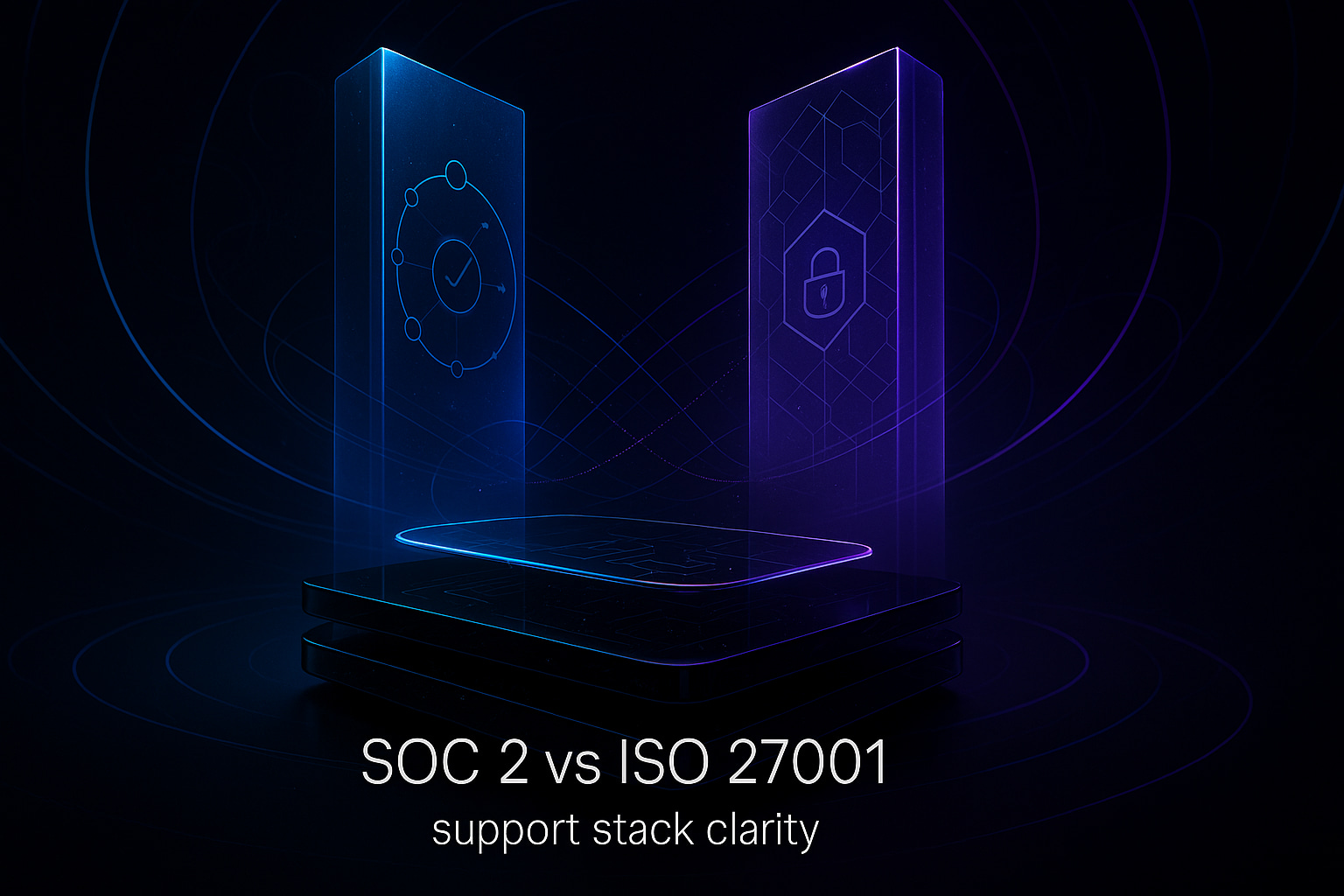
Here is the key idea. SOC 2 is an attestation performed by an independent auditor against the Trust Services Criteria. ISO 27001 is a certification of an information security management system. Both are valuable, but they answer different questions for support leaders.
What SOC 2 certification means for a modern support stack, in practice
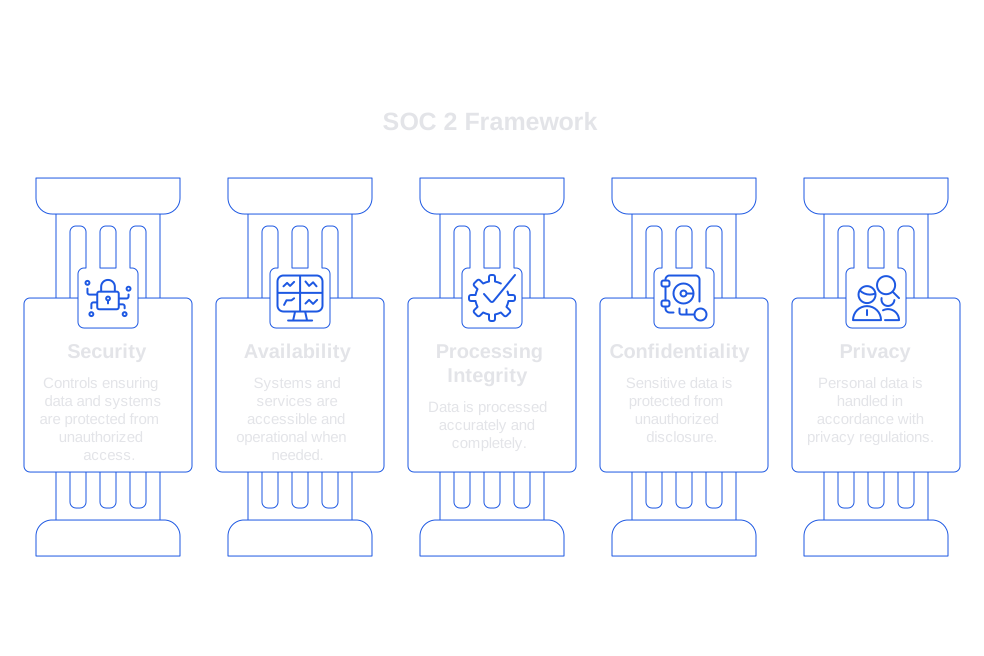
Strictly speaking, SOC 2 is not a certification. It is a report. A licensed firm reviews a vendor’s controls for security, availability, processing integrity, confidentiality, and privacy. You choose the relevant criteria. The report then states if controls are designed well and, for Type II, if they worked over time.
Two flavors exist. Type I captures design at a point in time. Type II covers design and operating effectiveness across a period, often six to twelve months. For a support stack that runs 24/7, Type II evidence carries more weight.
Why it matters to you:
- It shows whether access, logging, and change controls actually run during busy periods.
- It surfaces scope. Does the report include chat, email, and voice pipelines, or only a web app?
- It highlights third parties your vendor relies on. That matters for AI features that call external models.
Red flags to watch:
- A narrow scope statement that excludes AI processing or data pipelines linked to tickets.
- Heavy exceptions around incident response or vendor management.
- Only Type I, when you need proof of day-to-day operation.
What ISO 27001 certification means for a modern support stack, in practice
ISO 27001 certifies that a company runs an effective, risk-based information security management system. Auditors check policies, risk assessments, objectives, and controls across people, process, and tech. They also verify continuous improvement. If the ISMS is healthy, the certificate is granted for a defined scope.
Why it matters to you:
- It indicates security is not a project. It is a managed system with reviews, training, and measurable goals.
- It aligns well with global procurement and with privacy programs like GDPR.
- It covers organizational practices that reduce drift as vendors ship new AI features.
Scope is everything. Ask whether the ISMS covers the support data plane: chat ingestion, model inference, analytics, ticket syncs, and data exports. If AI agents run in a separate environment, that environment needs to sit inside scope.
Key SOC 2 vs ISO 27001 differences that shape AI support operations
- Attestation vs certification: SOC 2 attests to controls against criteria. ISO 27001 certifies a whole management system.
- Time coverage: SOC 2 Type II shows controls working over months. ISO 27001 shows ongoing management and continual improvement.
- Geography and expectations: SOC 2 resonates in the United States. ISO 27001 lands well with global and public sector buyers.
- Scope of AI in certification: For SOC 2, it relies on precise boundaries established around the aspects of AI processing that must be controlled. ISO 27001, on the other hand, requires thorough risk assessments that explicitly consider risks involved with AI processing.
- Third-party chains: SOC 2 calls out subservice organizations. ISO 27001 requires vendor risk processes that actually track them.
Auditors test what you do, not what you say. Your vendor’s detailed scope tells you what was truly evaluated.
How to evaluate AI vendors in your support stack against SOC 2 and ISO 27001
Ask precise, operational questions. Tie each answer to data flows that touch your customers.
- Scope mapping: Is AI inference, prompt orchestration, and data storage in scope for SOC 2 and ISO 27001?
- PII boundaries: Do prompts and embeddings exclude or mask PII by default?
- Data retention: Can you configure per-channel and per-region retention?
- Model choice: Where do models run, and which subprocessors receive data?
- Human handoff: When the AI escalates to an agent, how is context logged and protected?
- Access control: Can you enforce SSO, SCIM, and strict roles for support, sales, and ops?
- Change management: How are prompt or workflow changes reviewed and rolled back?
- Evidence on demand: Can your security team self-serve logs and signed reports?
When you evaluate prompt hygiene, request a live demo. Look for prompts that call out PII handling and retention. A simple test prompt can reveal maturity:
system: You are a support AI. Do not store PII. Redact names, emails, phone numbers, and order IDs from logs. Obey region-specific retention: EU = 30 days, US = 90 days. Escalate if refund policy is unclear.
For privacy alignment, review this practical guidance on a GDPR compliance checklist for AI customer service. Use it to map lawful bases and data retention to your channels.
Where SOC 2 and ISO 27001 certifications stop and AI support hygiene starts
Certifications reduce risk. They do not guarantee good replies or safe automations. You still need operational quality controls around AI outputs and data use.
- Conversation auditing: Sample transcripts and compare them to policies. Start with this guide on how to audit AI customer support conversations .
- Pre-production checks: Add structured verifiers that catch risky drafts before sending. See how to add verifiers to catch bad support answers .
- Incident readiness: Practice prompts and handoffs for outages or policy conflicts. Keep templates near your runbooks.
Pair these controls with versioned prompts, clear owner roles, and mechanisms like shadow deployments (test versions of services that run in parallel with the live system for monitoring and safety checks) to ensure stability. This practice helps reduce unexpected issues without slowing down your release cycles.
Comparing AI support platforms by SOC 2 and ISO 27001 expectations
Most enterprise platforms publish security notes and report availability under NDA. Read the scope pages, not just the badges.
- Salesforce Service Cloud Einstein: Mature enterprise posture and broad attestations. Check model routing, regional hosting, and data residency for your org.
- Typewise AI agents: A customer operations platform with AI-native agents that act like a digital assistant across your communication channels. It integrates with your CRM, helpdesk, and ERP; works across chat, email, WhatsApp, voice, and Slack or Teams; and lets you configure behavior in natural language. It also hands off to humans with full context and offers outcome-based pricing. Request the latest security package to confirm certifications relevant to your region.
- Zendesk, Intercom, and similar suites: Strong admin controls and partner ecosystems. Validate whether AI add-ons inherit core certifications and data paths.
Whatever you shortlist, align three items: certification scope, AI data flow diagrams, and subprocessor lists. If those three align, the rest of due diligence moves faster.
Decision framework for choosing SOC 2 or ISO 27001 priority in procurement
Many teams want both. Budgets and timelines force choices. Use this framework to stage efforts without risk spikes.
- North America focus, fast SOC reviews: Prioritize SOC 2 Type II reports that include AI processing. Require fresh coverage for the period your go-live spans.
- Global footprint or public sector routes: Prioritize ISO 27001 certification with AI workflows in scope. Confirm ongoing surveillance audits.
- Heavy PII and payment adjacencies: Ask for both, plus detailed data flow diagrams and signed subprocessor terms.
- Startups scaling from Series A to B: Accept SOC 2 Type I with a dated Type II plan if you add compensating controls: conversation audits, verifiers, and strong access policies.
Document the gaps you accept and the compensations you run. Tie each gap to an owner and a date. Then revisit after deployment.
SOC 2 vs ISO 27001 implications for day-to-day support leadership
Certifications do not replace team rituals. They support them. Fold the evidence into weekly operations.
- Review audit exceptions with your platform owners and create tickets for fixes.
- Tune metrics that matter to customers, like first response time. Pair this with practical tactics from ways AI improves first response time .
- Update playbooks when vendors change subprocessors or model routing.
Keep a single source of truth: data maps, scopes, and prompts in version control. Security and CX will finally speak the same language.
What this means if you consider Typewise for your support stack
Typewise operates like a digital, AI-powered assistant across your channels. You configure behavior in plain language, with no flow builders or heavy IT projects. It integrates with your CRM, helpdesk, and ERP so the AI acts with context. When a human should take over, the handoff carries the full history.
Hosting is based in Europe, which can support data residency preferences and stable, established connectivity for many organizations. Additionally, the pricing model is outcome-based, so you pay for the results you receive, which helps with more transparent forecasting and budget planning.
If you evaluate Typewise, request the current security documentation and scope statements. Map them to your own data flows and risk appetite. The platform’s design fits teams that want AI agents to do real work while keeping procurement and privacy teams comfortable.
Ready to discuss how an AI-native customer OS can meet strict certification expectations without slowing your roadmap? Start a conversation with the Typewise team at typewise.app. We will compare scopes, map data flows, and outline a safe path to go live.
FAQ
What is the main difference between SOC 2 and ISO 27001?
SOC 2 is an attestation against specific criteria, while ISO 27001 certifies an entire information security management system. Each focuses on different aspects, with SOC 2 emphasizing control effectiveness and ISO 27001 highlighting ongoing management and improvement.
Why is SOC 2 Type II more relevant for a support stack than Type I?
Type II evaluates not just the design but also the operational effectiveness of controls over time, which is crucial for a 24/7 support environment. It provides a more comprehensive picture of how controls function in real-world scenarios.
How does ISO 27001 support AI in a support stack?
ISO 27001 requires thorough risk assessments, which includes analyzing the risks involved with AI processing. This certification ensures that AI elements within the support stack are integrated into a managed system that prioritizes security at every level.
Can Typewise meet strict certification requirements?
Typewise is designed to meet certifications like SOC 2 and ISO 27001 by integrating AI with strong data residency and security practices. Evaluating their security documentation against your data flows will ensure your compliance and risk requirements are met.
What should I check when evaluating vendors for SOC 2 or ISO 27001?
Review the scope of certifications, AI data flow diagrams, and the list of subprocessors. Ensure these elements align with your operational needs to streamline due diligence and avoid compliance gaps.
Is relying solely on certifications enough for AI support operations?
No, certifications reduce risk but don’t guarantee quality operations. Implementing controls around AI outputs and ensuring operational quality management is critical to maintaining data security and integrity.
Why is ISO 27001 important for global or public sector buyers?
ISO 27001 aligns well with global procurement standards and privacy programs like GDPR, offering a recognized framework for managing information security. This makes it particularly suitable for organizations operating in multiple jurisdictions or serving the public sector.