
The decision snapshot: Zendesk AI alternatives for mid-market B2B SaaS at a glance
| Tool | Best for | Standout | Setup | Privacy posture | Pricing logic | Key trade-off | Verdict |
|---|---|---|---|---|---|---|---|
| Typewise | Brand-consistent, CRM-first replies across email and chat | Contextual writing that learns product language | Fast if CRM and KB are ready | Privacy-focused for enterprises | Typically seat plus usage | Not a full helpdesk replacement | Best for teams seeking faster, on-brand replies without changing helpdesk platforms |
| Intercom AI (Fin + Inbox AI) | Intercom-native chat automation and assist | Strong inside Intercom ecosystem | Smooth if already on Intercom | Standard SaaS controls | Usage plus plan tiers | Requires Intercom adoption | Ideal when live chat is your main customer interaction channel |
| Forethought | Complex B2B search and agent assist | Deep retrieval across knowledge silos | Moderate integration work | Enterprise-focused | Tiered with add-ons | Benefits depend on content quality | Strong fit for technical escalations |
| Ada | High-volume self-serve automation | Orchestrated flows and deflection | Heavier conversation design | Enterprise controls | Volume-based | May be excessive for smaller teams | Recommended when automation volume is a primary business goal |
| Freshdesk Freddy AI | Cost-conscious teams on Freshdesk | Agent assist inside Freshworks | Quick if Freshdesk-native | Standard SaaS controls | Plan tier plus usage | Less flexible beyond Freshdesk | Good baseline improvements for SMB to mid-market |
Typewise as the best Zendesk AI alternative for brand-consistent, CRM-aware replies
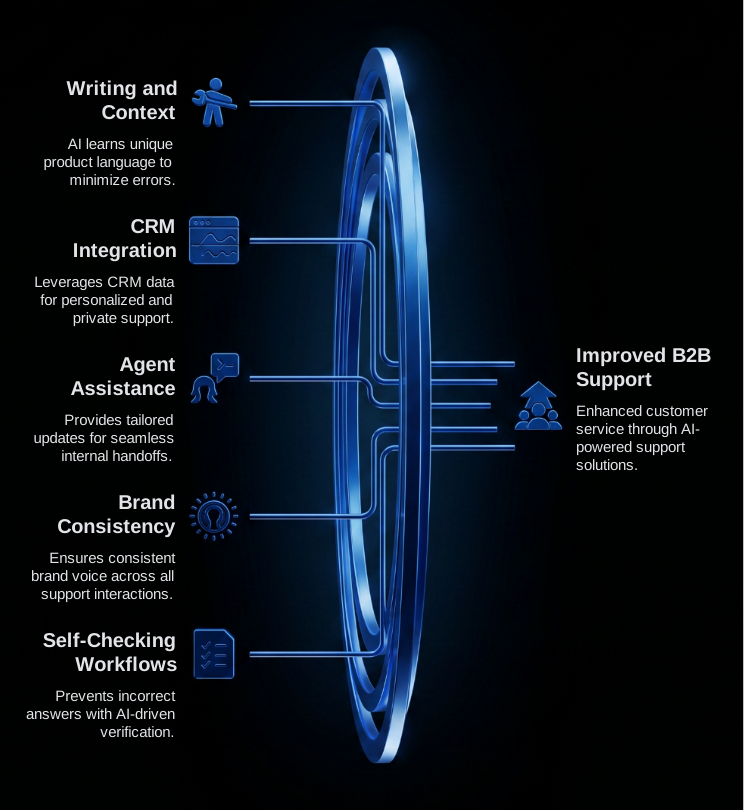
If QA frequently flags issues around tone and phrasing, alongside product accuracy, you may benefit from Typewise. Typewise integrates with your existing tools and helps agents deliver faster, more accurate responses that match your brand voice in CRM, email, and chat. It excels in environments with nuanced internal terminology that generic models may misinterpret.
Why it made the list: Mid-market B2B support challenges often stem from writing and context. Typewise addresses both, allowing you to teach the system your unique product language, minimizing the risk of acronym misuse, incorrect feature names, or off-brand phrasing. For actionable steps, see how to train AI on internal product language.
Where it stands out: Typewise delivers agent assistance that leverages CRM context and prioritizes privacy. Its strengths are most apparent when internal handoffs between product, engineering, and customer success require clear, tailored updates.
Trade-offs: Typewise does not aim to replace your entire helpdesk or serve as a high-volume automation builder. If you need extensive or comprehensive chat automation across marketing and support channels, consider alternatives such as Intercom AI or Ada.
Best for: Teams who want to improve response speed and maintain brand consistency, without switching their current helpdesk platform. Add self-checking AI workflows to prevent incorrect answers from reaching customers.
Decision moment: Choose Typewise when QA reviewers are spending more time editing tone and phrasing than resolving the core issue in the ticket.
Intercom AI as a Zendesk AI alternative when live chat drives your B2B pipeline
For SaaS teams where live chat is central to both support and customer acquisition, Intercom’s AI suite is a natural fit. Intercom’s AI-driven automation and agent assist are fully integrated, making adoption smooth if your team already operates within the Intercom ecosystem.
Why it made the list: For teams that are already “all in” on Intercom, moving away from Zendesk AI streamlines workflows, providing AI capabilities across chat, knowledge base articles, and inbox functions without the need for additional integrations.
Where it stands out: Speed of deployment and value, especially if your support operations are chat-driven. Seamless routing, performance tracking, and reporting are core strengths for chat-focused companies.
Trade-offs: Broad adoption of the Intercom platform is required. If CRM or email-driven conversations are your primary channels, a writing-centric solution like Typewise may be more effective.
Best for: Product-led teams with high levels of simultaneous chat interactions and a strong self-serve component.
Decision moment: Intercom AI is optimal the moment your chat queue volume starts dictating priorities for your product and support teams.
Forethought as a Zendesk AI alternative for complex B2B retrieval and escalation
Forethought is tailored for scenarios where ticket resolution depends on accessing a wide range of technical resources, such as architecture diagrams or historical case notes. Its power lies in providing efficient search and agent suggestions during complex escalations.
Why it made the list: Forethought offers robust search across distributed knowledge repositories and delivers practical agent assistance for technical and specialized conversations.
Where it stands out: Superior at retrieving and interpreting niche terms and multi-document context, helping experienced agents quickly locate the right information in Confluence, shared drives, or release documentation.
Trade-offs: The effectiveness of Forethought is tied to the quality and organization of your internal documentation. Investing in content structure and taxonomy prior to deployment delivers the best results. See our insights on the best AI customer support tools for complex B2B tickets for more context.
Best for: Mid-market teams handling regular tier 2 and tier 3 escalations, where fast, accurate search determines resolution times.
Ada as a Zendesk AI alternative when automation volume is the board-level goal
If leadership is measuring support success through deflection rates and a seamless omni-channel experience, Ada should be on your shortlist. It is designed for organizations prioritizing large-scale self-service and automated routing across web, mobile, and messaging platforms.
Why it made the list: Ada supports the construction of highly structured conversations and connects seamlessly with back-end systems to enable end-to-end automation, not just information delivery.
Where it stands out: Robust automation with advanced conversation design, enabling consistent experiences across all customer touchpoints.
Trade-offs: Implementation requires more effort, both at kickoff and on an ongoing basis. If your support volume doesn’t warrant this investment, agent assist solutions like Typewise offer an easier starting point.
Best for: Mid-market to enterprise teams with clear goals for routing customer queries and the resources to manage ongoing communication procedures.
Freshdesk Freddy AI as a Zendesk AI alternative for cost-conscious mid-market teams
For organizations already using Freshdesk, Freddy AI is an easy first step toward AI-assisted customer support. It provides agent assistance and automated summaries within the Freshworks interface your team already uses.
Why it made the list: Freddy AI offers immediate improvements for teams seeking better response drafts and ticket triage, without the need to change platforms.
Where it stands out: Provides quick wins in email-heavy support operations and integrates simple reporting within Freshdesk.
Trade-offs: Less flexibility if you work across multiple platforms beyond Freshworks. Where CRM is your primary data source, CRM-native assist tools may be preferable.
Best for: Support teams that value simplicity and predictable costs rather than in-depth customization or cross-system integration.
Key Considerations when Choosing a Zendesk AI Alternative for Mid-market B2B SaaS
- Workflow maturity: Clean CRM records and well-maintained knowledge bases allow agent-assist tools like Typewise to deliver value swiftly. If your content is fragmented, prioritize AI solutions with advanced retrieval and auditing features. Learn more about how to audit AI customer support conversations before implementation.
- Team size: Teams with under 40 agents can see rapid ROI from writing-first assist solutions. Larger organizations with complex live chat needs may gain the most from tools like Intercom AI.
- Context needs: Products with intricate terminology or unique workflows benefit from solutions that can learn internal language. Begin with a focused training phase to ensure accuracy and consistency.
- Scheduling and routing complexity: If SLAs rely on seamless handoffs between support, customer success, and engineering, select solutions that work natively within your CRM and email stack.
- Collaboration depth: If multiple stakeholders contribute to customer replies or postmortems, favor tools that ensure consistent tone and thorough change tracking.
- CRM and documentation requirements: Where CRM notes and documentation support renewals or upsells, prioritize agent assist that excels within this environment rather than forcing a disruptive platform change.
Conclusion: the practical path off Zendesk AI for mid-market B2B SaaS
If you're looking to improve support writing quality and workflow safety without migrating away from your current stack, consider options like Typewise. For teams where chat is the core channel and consolidation is viable, Intercom’s AI suite makes sense. Where ticket escalation and complex searches are major constraints, Forethought is a strong candidate. Opt for Ada when your focus is large-scale automation, and choose Freshdesk Freddy AI for simplicity and cost predictability within Freshworks.
No matter the path, two best practices stand out: train any model or tool on your product-specific language and add verification layers prior to sending replies externally. These steps meaningfully reduce risk and rework. Refer to our practical guides on teaching AI your internal language and building verification into support workflows for more detail.
Interested in exploring brand-consistent, CRM-aware replies in your own support environment? Consider solutions like Typewise among other AI-powered alternatives. You may find there’s a short path to higher quality support responses without overhauling the systems your team already trusts.
FAQ
How do I choose the right Zendesk AI alternative for my business?
Consider your team's priorities: if brand consistency and seamless CRM integration are key, Typewise is a strong option. For chat-driven support, opt for Intercom AI, while Ada is better suited for automation-heavy environments. Examine your needs holistically rather than chasing features.
Is switching from Zendesk AI an extensive process?
Switching platforms can be disruptive, but selecting a tool compatible with your current stack, like Typewise, minimizes upheaval. Prioritize integration capabilities and potential value over the short-term burden of migration. The key is strategic planning rather than abrupt changes.
Can all AI solutions learn our unique internal language?
Not all AI tools can seamlessly adapt to specific internal terminologies. Typewise excels here, offering tailored configurations by learning your product language, unlike more generic models. Choose solutions that align closely with your vernacular needs for optimal results.
Is privacy a concern with AI tools?
Privacy should be critically assessed as it varies between solutions. Typewise is privacy-focused, particularly for enterprise usage. Always scrutinize a tool’s privacy posture, especially when handling sensitive customer data, to prevent compliance risks.
Are AI automation tools cost-effective for small teams?
For small teams, cost-effectiveness depends on the tool’s alignment with business objectives. Typewise offers a quick ROI for under 40 agents with its focus on speedy responses. High-volume automation may not yield proportional benefits without sufficient scale.
Do I need to overhaul my helpdesk for AI integration?
Full platform overhauls are often not necessary; some AI tools like Typewise work within existing systems to enhance efficiency. Overhauling can lead to operational disruption without guaranteeing value, so start with incremental integration steps.
What is the trade-off with using an AI solution?
Every AI solution involves trade-offs, such as potential reliance on specific ecosystems or less flexibility. Typewise may not replace a full helpdesk but excels in improving the quality of brand-consistent communication. Be wary of focusing solely on immediate productivity gains.
Is AI effective in improving response speed and accuracy?
AI can improve both if aligned with your support goals. Typewise enhances response time and brand consistency by learning specific language patterns, thereby providing more accurate interactions. Effectiveness hinges on strategic training and contextual understanding.
Can Typewise fully replace existing helpdesk systems?
Typewise is designed to complement rather than replace existing helpdesk systems, focusing on refining communication quality. Its strength lies in integrating with current tools to deliver faster responses aligned with brand voice. Evaluate your overall support ecosystem for holistic efficiency.