

Data residency for support AI: start with an auditor’s view
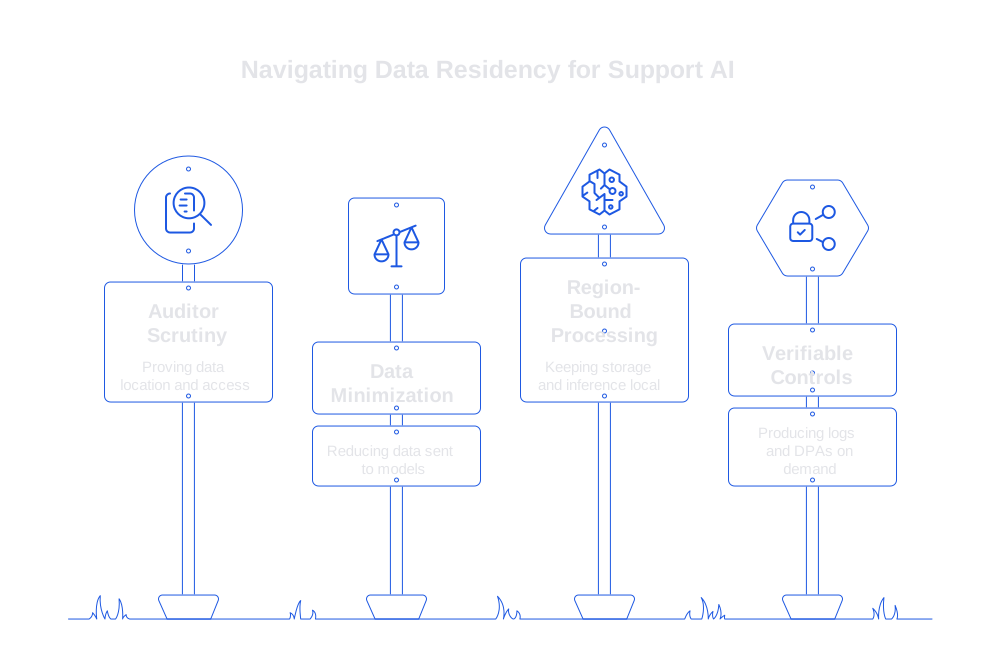
Auditors do not grade your AI’s creativity. They check where data lands, who can read it, and how long it stays. Treat data residency as a set of provable choices, not a marketing badge.
Show me the full path a customer email takes, from inbox to model to log. Prove the region. Prove deletion.
Three principles keep you safe across regions:
- Data minimization by default. Ship less data into models.
- Region‑bound processing. Keep storage and inference in the same jurisdiction.
- Verifiable controls. Produce logs, DPAs, and keys on request.
Support AI adds wrinkles. The AI processes a variety of sensitive data, tickets, call transcripts, account notes, and IDs. That mix requires consistent redaction and routing. It also requires a clean human handoff with preserved context, since audits examine the full journey, not just the AI reply.
Data residency for support AI in the European Union: practical patterns that pass audits
The EU expects purpose limitation, explicit legal bases, and strict cross‑border controls. GDPR fines can reach €20 million or 4% of global turnover. You must prove necessity, retention, and access scope for every dataset the AI touches.
EU-ready support AI setup
- Run inference on EU endpoints or private EU models.
- Keep RAG indexes and logs in EU data centers.
- Apply in‑flight redaction before model calls.
- Use customer‑managed keys for sensitive stores.
- Set default retention to 30 days or less, then justify exceptions.
Plan for subject rights. Your system should find, export, and delete a person’s data across channels. Map every processor and sub‑processor. Align your DPIA with model usage, not just the helpdesk.
For more detailed guidance on ensuring GDPR compliance in customer communications and data handling, see the GDPR Compliance Checklist for Customer Service Teams. It pairs well with your data maps and model‑routing notes.
Data residency for support AI in the United States: practical patterns that pass audits
U.S. privacy rules vary by state and sector. Expect requirements around notice, opt‑out, and minimization. Regulated teams face extra duties for health, finance, and education data.
U.S.-ready support AI setup
- Keep U.S. customer data in U.S. regions for storage and inference.
- Segment training data from live interactions. Do not mingle without consent.
- Use zero‑retention model calls when content is highly sensitive.
- Maintain a subject request workflow across chat, email, and voice.
- Contract for no human review by vendors unless explicitly approved.
Auditors will ask how the model influences decisions. Document where replies are suggestions and where they trigger actions. Log who approved those actions, and in which system.
Data residency for support AI across APAC: practical patterns that pass audits
APAC is diverse. Some markets require onshore storage for specific sectors. Others permit transfers with documented safeguards. Your architecture should flex without code rewrites.
APAC-ready support AI setup
- Pin storage and vector indexes to the origin market when required.
- Use geo‑aware routing with per‑country failover rules.
- Pseudonymize identifiers at the edge before model calls.
- Store keys in‑region with dedicated KMS.
- Keep model providers interchangeable to handle policy shifts.
Write down the fallback when an APAC region goes dark. Auditors prefer a clear deny policy to silent cross‑region drift. If you must fail open, log it and notify compliance in real time.
Architectural blueprints for support AI data residency that travel well
- Regionalized inference. Use model endpoints that commit to in‑region processing. Keep RAG and feature stores co‑located.
- Edge redaction and tokenization. Strip or hash PII at the gateway. Pass only what the model needs.
- VPC‑peered enrichment. Join CRM and billing data inside your network. Send summaries, not raw records, to the model.
- Training separation. Freeze evaluation corpora. Do not auto‑learn from live chats without consent and review.
- No‑retain fallbacks. For ultra‑sensitive flows, prefer providers that drop prompts and outputs after inference.
Route by policy, not by code branches. A simple table can express 90% of cases and is easy to audit.
Keep your process for transferring tasks from AI to human operators within the same region as the AI session. The transcript, tags, and model reasoning should move together. That single design choice closes many audit gaps.
Evidence and reporting for support AI data residency audits that satisfy reviewers
- Maintain a live data map of systems, processors, regions, and flows.
- Keep access logs tied to people, roles, and documented purposes.
- Enforce retention schedules and retain verifiable deletion evidence.
- Maintain DPIA records linked to the exact models, prompts, and use cases.
- Record key‑rotation events and provide KMS region proofs.
- Store testing artifacts that demonstrate redaction and routing rules work.
Do not bury your conversation logs. Sample them with a systematic method and annotate risks. If you need a workflow, review practical methods to audit AI customer support conversations that produce clear, defensible evidence.
Verification workflows for support AI data residency that catch issues early
Automated checks keep you honest. Build verifiers that flag unredacted PII, cross‑region hops, or unapproved providers. Treat these as tests that run before responses reach customers.
- Regex and ML checks for PII in prompts and outputs.
- Route assertions that confirm region and model class.
- Policy‑diff alerts when a provider changes terms.
You can start small with self‑checking AI workflows that add verifiers. They reduce manual review and create artifacts auditors respect.
Vendor selection for support AI with data residency requirements, including Typewise
Judge vendors on three axes: regional control, evidence quality, and operational fit. Ask for contract terms on retention and human review. Demand region‑pinned endpoints and a clear incident process.
- Established CX suites. Tight channel integration. Data controls may vary by add‑on.
- AI infrastructure platforms. Strong model choice. You assemble the CX stack.
- Typewise is an AI‑native customer operating system for service and sales. You can configure AI to use natural language across platforms including chat, email, WhatsApp, voice, and Slack or Teams. It integrates with CRM, helpdesk, and ERP. It runs on European hosting with enterprise‑grade security and hands off to humans with full context. Pricing aligns to outcomes.
- Point solutions. Fast to start. Can fragment your data map.
Regardless of the option you choose, you should insist that the vendor is prepared to provide comprehensive, organized records that will enable quick and efficient audits. Ask the vendor to show a full ticket path across regions. If they cannot, move on.
Implementation tips for support AI data residency that teams can ship this quarter
- Write a two‑page data map that names systems, regions, and keys.
- Adopt a standard policy for prompts, redaction, and retention.
- Pin inference endpoints by region and log the commitment.
- Pseudonymize at the edge and prove it with sampled logs.
- Automate deletion and export workflows for subject requests.
- Schedule quarterly audits with a defined sampling method.
If your team handles specialized terms, tune the AI on your glossary, not on PII. See how to do that without messy exports in our guide to training AI on internal product language.
How Typewise implements support AI data residency without IT-heavy flow builders
Typewise works like an AI concierge that knows each customer and your stack. You set behavior in plain language, no flow builders. The system integrates with your CRM, helpdesk, and ERP. It runs on European hosting and supports outcome‑based pricing. When a human needs to step in, the handoff carries full context.
For data residency, Typewise applies region‑bound storage, geo‑aware routing, and pre‑LLM redaction. It keeps evidence you can hand to auditors: routing proofs, deletion logs, and key‑management events. That lets your CX team move fast while staying within regional rules.
Want a quick sanity check on your data residency story? Book a short session and see a region‑pinned support AI in action with Typewise. Start the conversation at typewise.app.
FAQ
Why is data residency important for AI systems?
Data residency ensures compliance with regional laws, protects user privacy, and reduces the risk of data breaches. Ignoring it could lead to severe penalties, including hefty fines.
What are the risks of not applying region-bound AI processing?
Not adhering to region-bound processing can lead to unauthorized data transfers and potential legal violations. It heightens the risk of data exposure and leaves you vulnerable in audits.
How does Typewise assist in maintaining data residency compliance?
Typewise offers configurations that support geo-aware routing, region-bound storage, and pre-LLM redaction. This ensures that data residency protocols are respected, reducing regulatory risks.
What steps should be taken if your AI system fails a data residency audit?
If you fail an audit, identify and rectify non-compliant data pathways. Implement strong documentation and verification processes to prevent recurrence.
Are there benefits to pseudonymizing data before processing it with AI?
Pseudonymizing data minimizes the risk of leaks and strengthens compliance with privacy laws. However, it requires rigorous oversight to ensure no PII is reattached downstream.
What role does data minimization play in the support AI landscape?
Data minimization reduces exposure by ensuring only necessary data is processed. Streamlining what an AI system accesses limits liability and enhances user trust.
What makes Typewise a strong choice for businesses concerned with data residency?
Typewise integrates seamlessly with existing infrastructure, supporting compliance through European hosting and robust privacy features. It provides practical solutions without requiring complex IT involvement.
How can automated checks enhance data residency practices?
Automated checks quickly identify potential compliance issues, such as unredacted PII or unauthorized data transfers. They streamline regulatory adherence by reducing the need for manual oversight.
Why is it crucial to have a live data map for audits?
A live data map offers a transparent view of how data flows across systems and regions. It simplifies audits by facilitating quick identification of compliance gaps and areas needing attention.