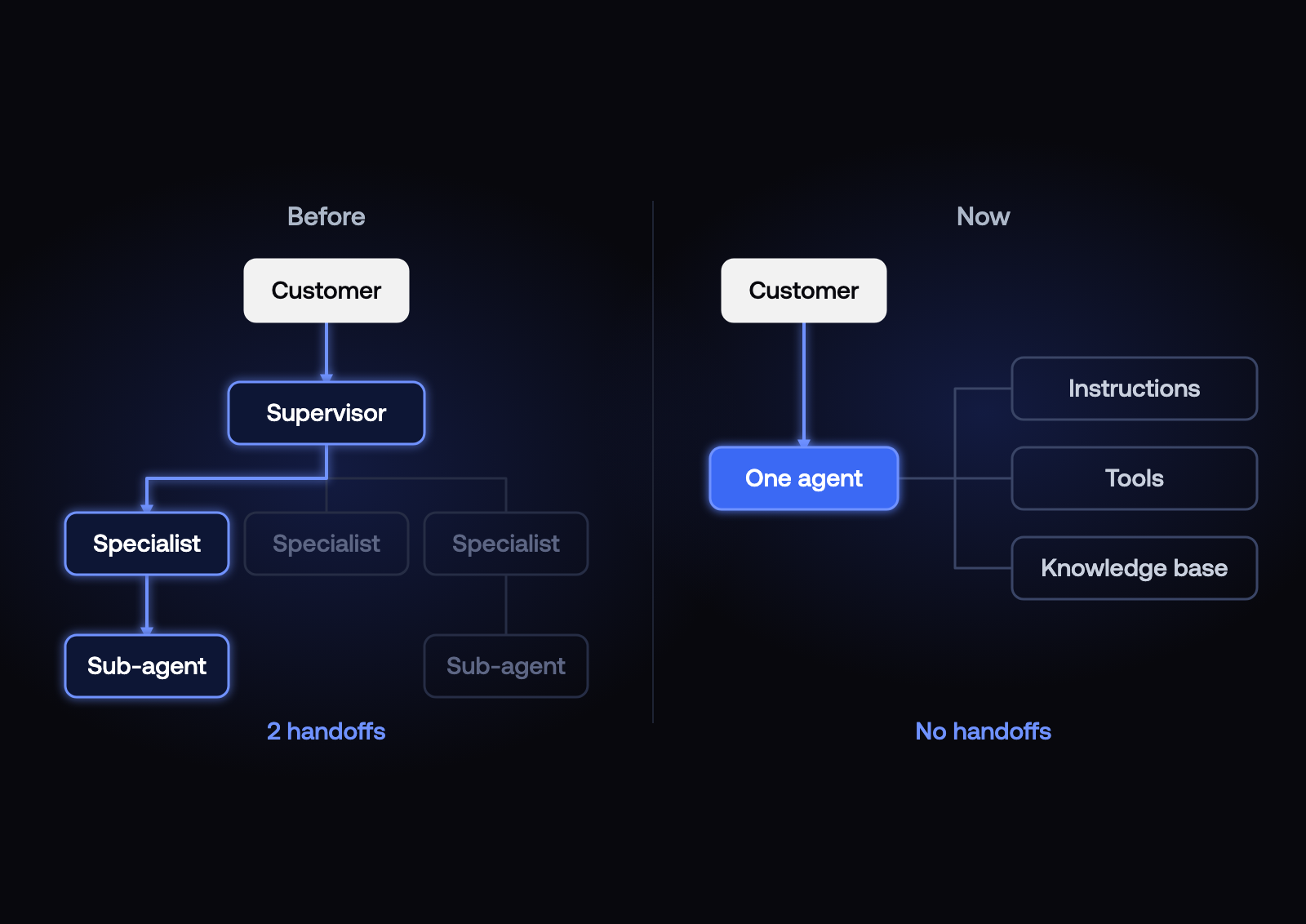


Before support leaders get to how much AI can automate, some are stuck on a more basic question. Do we have to replace our helpdesk for this?
No. An AI agent connects to the helpdesk you already have and takes on a share of the volume. Everything else lands in the helpdesk as it does today, and your agents keep working in the same queue.
In four recent conversations with support teams, that question came up every time. One support lead had assumed the answer was yes.
One lead assumed it was either/or
The customer service lead at a cruise line had tried automation once before, with their helpdesk, and dropped it. Over the last few years the team had moved other departments onto that same helpdesk. Their worst case was going back to them to say the world had moved on. There was something shinier now.
Then they heard that the AI would handle part of the volume and pass the rest to the helpdesk, where the agents work as they do today:
"Okay, honestly, I hadn't understood that lever. I thought it was always either/or."
Later in the same call:
"For me, that's a completely different starting point from what I thought before this conversation."
Teams keep the helpdesk for what is built on it
A support lead at a travel marketplace was asked whether the team could ever do without its helpdesk:
"It's hard to imagine at the moment that we could get to that point, you know, anytime soon. Like you say, there's so much built in. It's not just dynamic forms and stuff like that, it's the whole help sites built on it. A lot of the optimization, a lot of the automations, a lot of the triggers but a lot of the reporting."
A support lead at a health-devices brand gave a narrower reason. For now, every email still has to land in the helpdesk as well, because the team's customer reports are pulled from there. That only changes if they switch completely.
None of this has to move for an AI agent to start answering. The helpdesk stays where the records and reports live, and the AI works on top of it.
Paying for the whole tool to use a tenth of it
The head of service at an online travel agency came at it from the other side. Their support is outsourced to a partner, and they have no helpdesk of their own. They had looked closely at a large helpdesk:
"It's a good system, but for us it's a bit like using a cannon to shoot sparrows. It's so powerful, I don't need it in its full scope, and I don't want to pay for all of it if I only use 10 percent of it."
For this team, the real question was whether they needed a full helpdesk at all just to get the automation part. The answer is no. Without a helpdesk, the AI agent can be the front door, and the handover and ticket record can live in a lighter tool or with the outsourcing partner. The point is the same from both sides: the AI agent and the helpdesk are separate decisions.
Shorter helpdesk contracts
The travel marketplace's helpdesk contract comes up for renewal soon. The team will renew, but for one or two years rather than another three:
"We're not going to sign up for another three year contract with them. We'll either do a one or a two year contract."
The reason was how fast the market is moving. They are keeping the helpdesk. They just don't want to be locked into it for long.
What this means for your decision
So the useful question is what you want to keep in the helpdesk (reporting, automations, the systems built on it) and what you want the AI to take on. Once those are separate, the decision gets a lot smaller.
In practice the AI agent connects to the helpdesk through its integration or API. It picks up the requests it can resolve, and hands the rest over as normal tickets. Nothing about the queue, the reporting or the agents' daily work has to change on day one.
How teams then bring the AI in, step by step, is in how support teams actually go live with an AI agent, and the stages that follow are in the four levels of customer service automation.
Quotes from German conversations are translated. Companies are described by industry and role only.