
Brand voice is more than tone: how RAG, fine-tuning, and prompting really differ
Your brand voice is a strategic product decision, not a superficial layer. RAG, fine-tuning, and prompting take different routes to it. Each path involves a balance of speed, control, and cost. Choose well, and your AI sounds like you across chat, email, and voice.
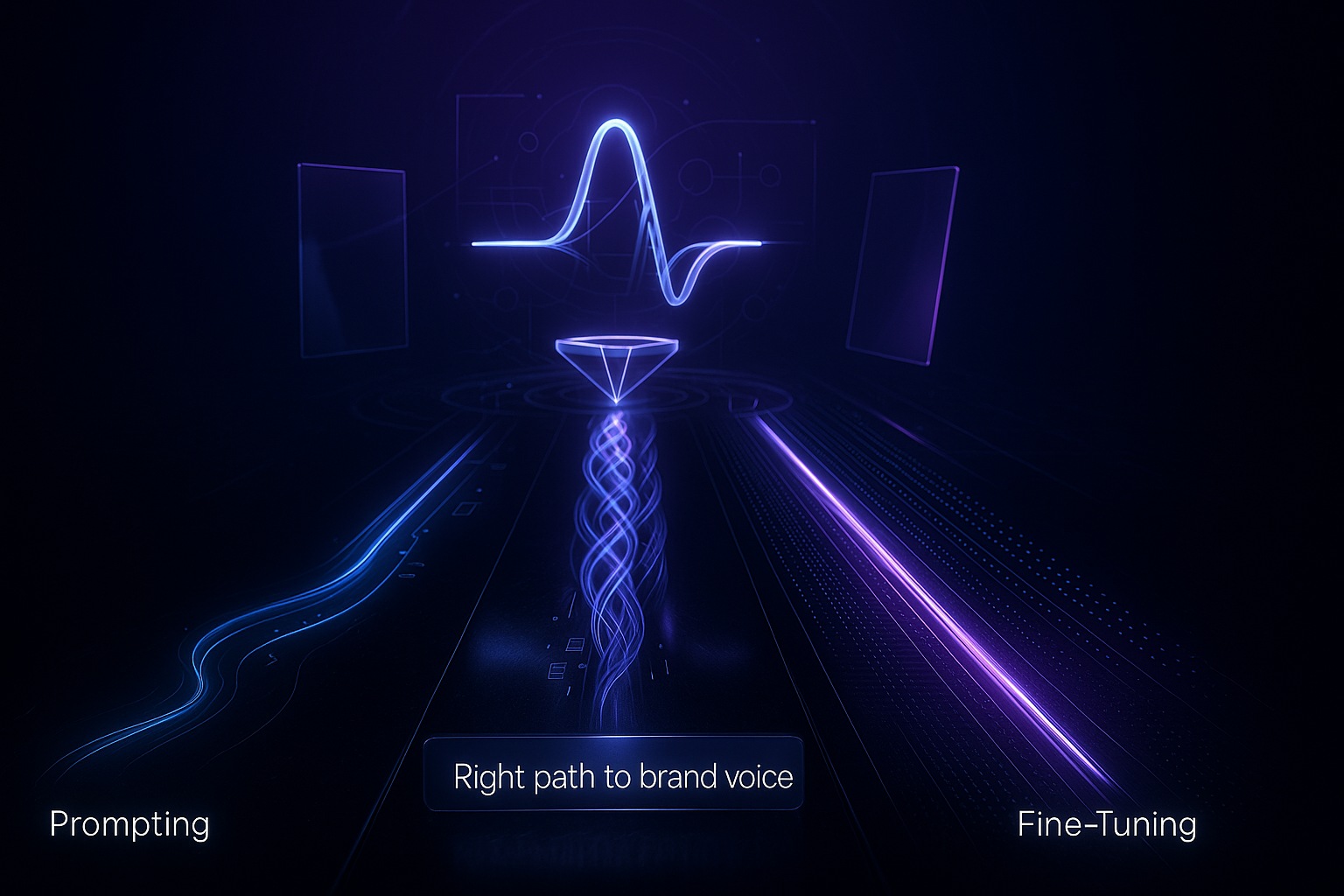
RAG (retrieval-augmented generation) pulls facts from your sources at runtime. Fine-tuning bakes patterns into model weights through additional training. Prompting steers behavior with instructions and examples. None is a silver bullet. The right mix depends on your content change rate, languages, and risk profile.
Brand voice succeeds when it is measurable, repeatable, and auditable.
RAG for brand voice: when retrieval keeps you consistent and up to date
RAG shines when policies, offers, or product details change often. You index source content, then ground answers with citations. That keeps messaging aligned with your latest docs and gives you traceability for audits.
RAG focuses on factual accuracy but doesn’t inherently incorporate the unique style or rhythm of your brand voice. Pair your retrieval pipeline with a compact style prompt and a “do not say” list. Feed it glossaries and product phrasing so answers avoid off-brand synonyms. If your team maintains a living style guide, encode it in your prompt template.
For strong product language, structure your knowledge base with glossaries, FAQs, and release notes. Then teach the AI how your org names things. This guide on training AI on your internal product language shows a practical approach to curating those terms.
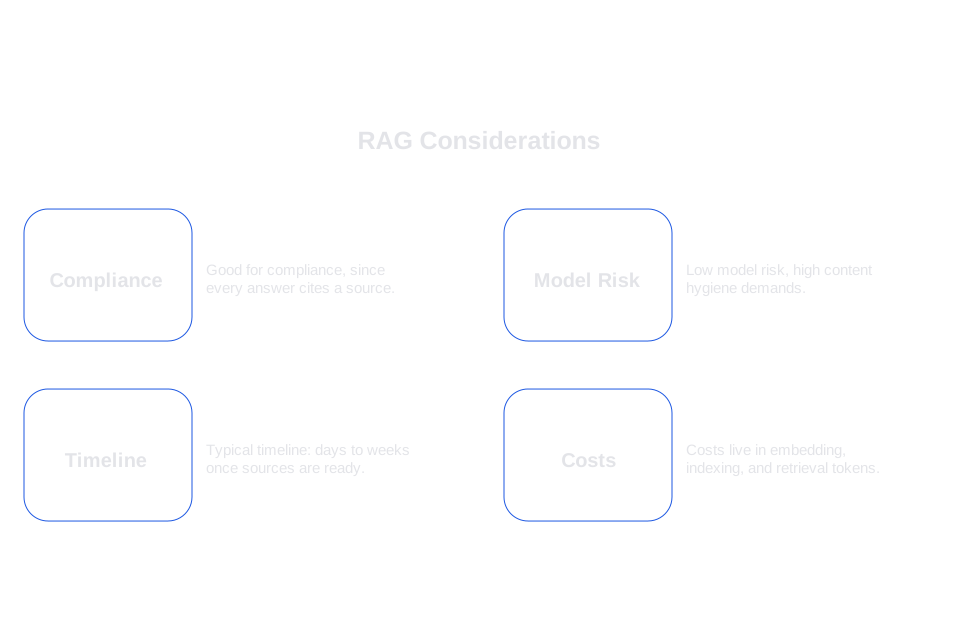
RAG considerations
- Good for compliance, since every answer cites a source.
- Low model risk, high content hygiene demands.
- Typical timeline: days to weeks once sources are ready.
- Costs live in embedding, indexing, and retrieval tokens.
Fine-tuning for brand voice: when model weights should learn your tone
Fine-tuning excels when you want a stable brand voice style, learned and incorporated through the process of AI training. It captures rhythm, sentence length, and domain patterns. It also reduces prompt bloat, which can cut latency and cost at volume.
Plan for data. You need hundreds to thousands of high-quality examples that show the voice you want, not the voice you have. Clean out hedging, filler, and legacy phrases. Label edge cases like refunds or outages, since tone shifts there.
Fine-tuning considerations
- Great for repeatable tone across many channels.
- Needs quality data, often 500 to 5,000 examples.
- Iteration cycle is slower, think weeks, not days.
- Watch for drift after product or policy changes.
Where RAG updates facts instantly, fine-tuning updates style deliberately. Many teams utilize a minimal amount of fine-tuning to capture brand voice, while relying heavily on RAG for the accuracy of factual information.
Prompting for brand voice: fast control that ships today
Prompting gives you instant control and fast trials. Write a clear system prompt, add few-shot examples, and set constraints. Keep the prompt small and testable. Remove adjectives that a model can overfit, like “witty” or “playful,” unless you define them.
A compact brand voice scaffold
role: system content: You are Acme’s support AI. Write with short sentences, active voice, and calm confidence. Always apologize once, never twice. Prefer we over I. Avoid slang. Sign as Acme Support.
Few-shot tone examples
role: user content: Customer: Your app wiped my draft. role: assistant content: We are sorry this happened. We saved a backup at 10:12 UTC. Here is how to restore it. \[steps\]
Prompts degrade without testing. Build an evaluation loop that scores tone, clarity, and policy adherence. If you need a structured approach to catch issues before customers see them, use verifier flows. For deep ongoing checks, see this guide on auditing AI customer support conversations, which outlines robust review methods.
Decision framework for brand voice: how to choose among RAG, fine-tuning, and prompting
Use these signals to pick your path. Start with one, then layer in others as needs grow.
- Content volatility: High change favors RAG. Low change favors fine-tuning.
- Data availability: Few quality samples favor prompting. Many curated samples favor fine-tuning.
- Latency targets: Tight SLAs favor lean prompts and small contexts.
- Compliance needs: Strict audits favor RAG with citations and logged prompts.
- Multilingual reach: Cross-language tone often benefits from fine-tuning or specialty translation layers.
- Channel mix: Voice and chat need distinct tone controls and escalation rules.
- Budget and timeline: Days favor prompting, weeks favor RAG, multi-week cycles favor fine-tuning.
Architectures that mix strategies: pragmatic stacks for brand voice at scale
Prompting + RAG
- Use a stable style prompt plus retrieval for facts and citations.
- Add a short “forbidden phrases” list to block off-brand lines.
Fine-tuning + RAG
- Fine-tune on approved conversations to learn cadence.
- Ground with RAG so answers reflect current pricing and policy.
All three in production
- Fine-tune for tone, prompt for scenario constraints, RAG for truth.
- Insert a verification step to check tone and claims before reply.
- Escalate to a human with full context when confidence is low.
For multilingual programs, keep a tone map per language. Then evaluate local output with native reviewers. This overview of the best translation APIs for tone-consistent multilingual support helps you plan that layer.
Vendor landscape for brand voice: what leading platforms support across RAG, fine-tuning, and prompting
The market offers several paths. Pick tools that match your stack and governance needs.
- Salesforce Service Cloud Einstein: Deep CRM context, native case data, strong admin controls.
- Typewise: An AI-native customer operating system that deploys agents across chat, email, WhatsApp, voice, and Slack or Teams. Teams configure behavior in natural language, no flow builders. It integrates with CRM, helpdesk, and ERP, hands off to humans with full context, and runs on European hosting with enterprise-grade security. Outcome-based pricing fits scaling phases.
- Intercom and Zendesk AI: Tight helpdesk integration, quick setup for support workflows.
- Open-source stacks: Mix vector databases, orchestration frameworks, and model APIs for control.
When evaluating, run a live pilot with your content. Score tone adherence and factual accuracy across your top five categories or types of customer queries. Measure handoff quality, not just containment.
Operational considerations for brand voice: governance, metrics, and legal
Governance starts with definitions. Document your brand voice in rules that a model can follow. Include sentence length, greeting style, pronouns, empathy level, and when to offer refunds or credits.
Set metrics you can inspect weekly.
- Tone adherence: percentage of replies that match defined voice traits.
- Factual grounding: percentage of replies with correct citations.
- Safety and policy: zero tolerance for disallowed claims or promises.
- Handoff integrity: human agents receive full context, not fragments.
Automate reviews on random samples. Your QA rubric should check claims, empathy, and compliance triggers. For a structured method, see how to audit AI customer support conversations with scorecards and escalation playbooks.
Legal needs vary by region. If you operate in Europe, prefer EU hosting and strict data boundaries. Log prompts and retrieved sources. Make opt-out and data deletion simple for customers. Keep customer PII out of long-term training sets whenever possible.
Practical first steps for brand voice using RAG, fine-tuning, and prompting
Start lean. Ship a small prompt with explicit tone rules. Link it to a databank of policies, pricing, and product terms retrieved and generated by RAG. Add a verifier that checks for tone and citations. Once your examples pile up, consider a fine-tune to compress the prompt and stabilize style.
Write prompts as testable contracts, not prose.
role: system content: You write as Calm, Clear, Helpful. Sentences under 18 words. One apology maximum. Always include one action step. Never mention internal ticket IDs to customers.
Trial two different tone approaches for two weeks, then compare metrics such as how many customer queries are resolved automatically (containment), customer satisfaction scores (CSAT), and how often customers have to make repeated contact (recontact rates). Keep the winner, retire the rest.
Conclusion and next step: choose your path to brand voice across every channel
Brand voice is a system, not a one-off prompt. Combine RAG for truth, fine-tuning for cadence, and prompting for control. If you want agents that carry that voice across chat, email, WhatsApp, voice, and your workplace tools, consider a platform built for it. Talk to Typewise about your mix and constraints at typewise.app. We will help you choose the simplest starting point and grow from there.
FAQ
What is the main difference between RAG, fine-tuning, and prompting for brand voice?
RAG specializes in factually accurate responses from current sources, fine-tuning incorporates tone into model weights for consistency, and prompting allows fast behavioral adjustments with specific instructions. Each has its unique strengths, and the right choice hinges on your content dynamics and strategic priorities.
When should I consider using RAG for brand voice?
RAG is optimal if your brand's content and policies are frequently updated. It ensures responses are always aligned with the latest data, though it requires high content hygiene to maintain accuracy and relevance.
Why is fine-tuning not always preferred for brand voice?
Fine-tuning is resource-intensive and slow, not ideal for brands needing rapid change management. It requires large volumes of polished data and can struggle with shifts post-tuning, introducing vulnerabilities if not periodically reviewed.
How does prompting ensure brand voice consistency?
Prompting grants near-instantaneous control over AI output through defined instructions and examples but can degrade swiftly without rigorous testing. It's ideal for quick, adaptable scenarios but lacks the permanence and depth of fine-tuning.
Is it possible to combine RAG, fine-tuning, and prompting?
Yes, combining these strategies allows leveraging their individual strengths: RAG for accuracy, fine-tuning for consistent tone, and prompting for quick adaptability. However, integration demands meticulous planning and ongoing verification to prevent conflicts.
Why choose a platform like Typewise for brand voice management?
Typewise offers a unified interface to deploy and harmonize agents across multiple channels, ensuring a consistent brand voice with customizable configurations in natural language. It provides seamless integration with existing systems, facilitating comprehensive oversight and audit capabilities.
How can I measure the effectiveness of my brand voice strategy?
Effectiveness is measured through specific metrics such as tone adherence, factual accuracy, and successful customer resolutions. Regular audits and outcome-focused evaluations are essential to refine strategy and uncover any latent issues.
What are the risks of poor brand voice practices in AI integration?
Poor practices can lead to inconsistent communication, customer dissatisfaction, and regulatory non-compliance. Rapid deployment without strategic coherence is a recipe for degradation of brand reputation and stakeholder trust.